
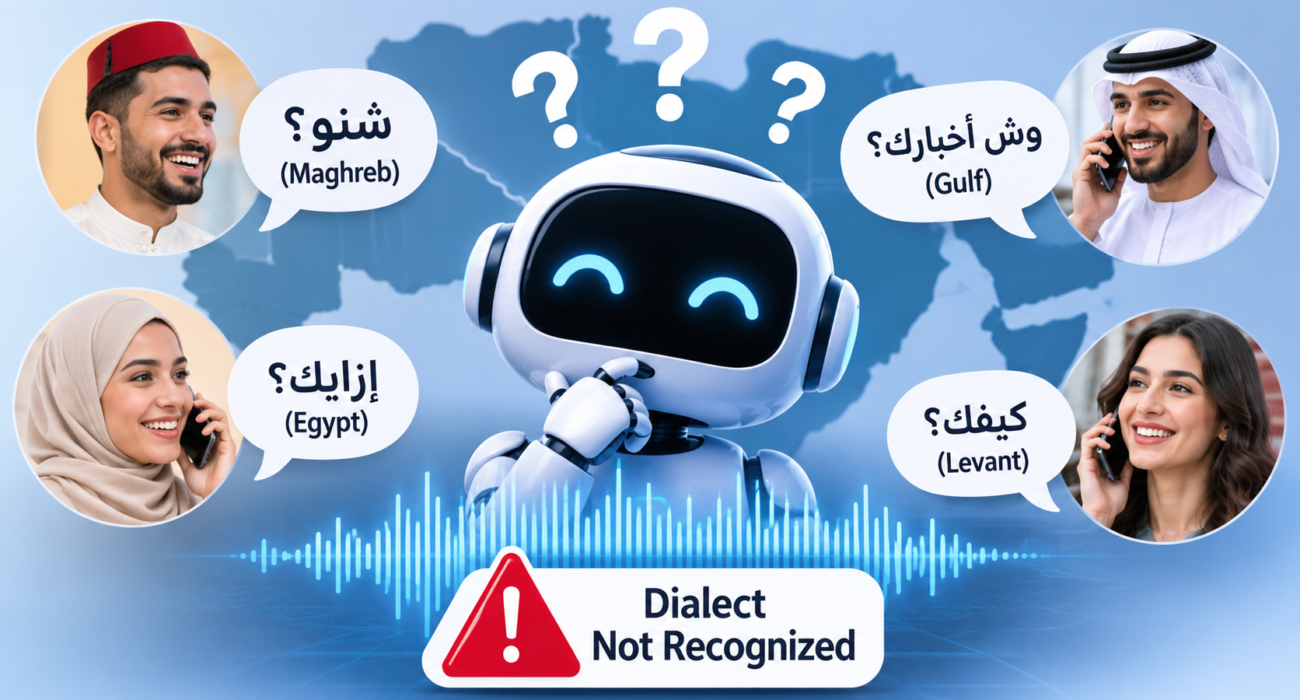
Arabic is spoken by hundreds of millions of people across the Middle East, North Africa, and beyond. However, Arabic is not a single, uniform spoken language. From Moroccan Darija to Egyptian Arabic, Levantine Arabic, and Gulf Arabic, speakers use different dialects that can vary significantly in pronunciation, vocabulary, grammar, and everyday expressions.
As voice assistants, speech-to-text applications, automated customer service platforms, and conversational AI tools become more widespread, understanding Arabic dialects is increasingly important. Building reliable Arabic voice AI requires more than collecting recordings in Arabic. It requires representative speech datasets that reflect how people actually speak.
In this article, we explore the main Arabic dialect groups, explain why they are difficult for AI systems to recognize, and examine how high-quality audio data and linguistic annotation can improve Arabic speech recognition.
1. Arabic Is a Language of Many Dialects
One of the most important characteristics of Arabic is the coexistence of Modern Standard Arabic (MSA) and numerous regional spoken varieties.
Modern Standard Arabic is commonly used in formal writing, education, news media, official communication, and public speeches. However, everyday conversations generally take place in local dialects, which are often quite different from the formal language.
Arabic speakers may switch between MSA and their local dialect depending on the situation, audience, and subject. This phenomenon is often called code-switching or register variation.
For speech recognition systems, this means that the language being processed can change significantly from one recording to another, or even within the same sentence.
Modern Standard Arabic vs. Spoken Arabic
Modern Standard Arabic provides a relatively standardized linguistic reference. Spoken dialects, on the other hand, reflect regional identities, cultural influences, and everyday communication habits.
For example, a formal Arabic sentence may use vocabulary and grammatical structures that are rarely heard in casual conversations. A speaker may also pronounce certain words differently or use a completely different expression depending on their region.
This distinction matters because an AI model trained mainly on formal Arabic may not recognize the vocabulary, pronunciation, and sentence structures used by everyday Arabic speakers.
2. The Main Arabic Dialect Groups
Arabic dialects are commonly grouped according to geographical and linguistic similarities. Although these classifications are useful, each group contains additional local varieties and differences between cities, regions, and communities.
Maghrebi Arabic: Moroccan, Algerian, and Tunisian Dialects
Maghrebi Arabic is spoken across North Africa, particularly in Morocco, Algeria, Tunisia, and parts of Libya and Mauritania.
Moroccan Darija, Algerian Arabic, and Tunisian Arabic share historical and linguistic features, but they also have distinct vocabulary, pronunciation patterns, and expressions.
These dialects are influenced by several languages, including Amazigh languages, French, and, depending on the region, Spanish and other languages.
Some common challenges for AI systems include:
- Pronunciation patterns that differ from Modern Standard Arabic.
- Regional vocabulary and expressions that may not appear in standard Arabic datasets.
- Frequent use of French or other foreign-language words in everyday speech.
- Differences in pronunciation between speakers from different cities and regions.
- Limited availability of large, accurately annotated speech datasets for certain varieties.
For example, Tunisian Arabic frequently incorporates French words into everyday conversations. A speaker may naturally combine Arabic and French vocabulary within a single sentence, creating additional difficulties for automatic speech recognition systems.
Egyptian Arabic
Egyptian Arabic is one of the most widely recognized Arabic dialects, partly because of the influence of Egyptian cinema, television, music, and digital media.
Despite its relatively strong presence in media content, Egyptian Arabic still differs from Modern Standard Arabic in pronunciation, vocabulary, and grammar.
AI systems must learn to recognize everyday Egyptian expressions, colloquial sentence structures, and variations in pronunciation across speakers. Training data based only on formal Arabic cannot fully represent these characteristics.
Levantine Arabic
Levantine Arabic is spoken in countries such as Lebanon, Syria, Jordan, and Palestine.
Although these varieties share many linguistic characteristics, they are not identical. Differences in vocabulary, pronunciation, and local expressions can affect how speech recognition systems interpret conversations.
Levantine Arabic also includes regional and social variations. A model that performs well on one variety may produce less accurate transcriptions when exposed to another.
Gulf Arabic
Gulf Arabic includes spoken varieties used in countries such as Saudi Arabia, the United Arab Emirates, Kuwait, Qatar, Bahrain, and Oman.
These varieties have their own pronunciation patterns, vocabulary, and expressions. Differences can also exist between urban and rural communities and between neighboring countries.
For AI developers, collecting speech data from multiple Gulf regions is important to avoid building models that perform well for only one specific group of speakers.
Sudanese and Other Regional Varieties
Sudanese Arabic and other regional varieties also contribute to the linguistic diversity of the Arabic-speaking world.
They may contain distinctive vocabulary, pronunciation patterns, and influences from local languages. Their representation in speech technology datasets can be limited compared with more frequently studied varieties.
Including these varieties in Arabic speech datasets helps improve linguistic coverage and makes AI systems more useful to a wider range of speakers.
3. Why Do Arabic Dialects Create Problems for AI?
Arabic dialect diversity is not simply a matter of different accents. It affects several fundamental components of automatic speech recognition, including vocabulary, pronunciation, grammar, and language modeling.
Different Vocabulary for the Same Meaning
Arabic speakers may use completely different words to express the same idea depending on their region.
A speech recognition model trained on one dialect may encounter unfamiliar vocabulary when processing another. If its training data does not contain enough examples of these expressions, it may replace them with more familiar words or produce inaccurate transcriptions.
This problem becomes particularly important when a model is expected to serve users from several Arabic-speaking countries.
Pronunciation and Accent Variation
Pronunciation differences can make it difficult for AI systems to identify individual words correctly.
Arabic dialects may differ in how certain consonants are pronounced, how vowels are realized, and how sounds change during connected speech. Even within the same dialect, speakers can have different accents, speaking speeds, and articulation habits.
Speech recognition models must learn to distinguish meaningful linguistic differences from normal variation between speakers.
Code-Switching Between Arabic and Other Languages
Many Arabic speakers naturally mix Arabic with French or English, particularly in professional environments, education, technology, and everyday digital communication.
This practice, known as code-switching, creates additional challenges for speech recognition systems.
For example, a Tunisian speaker may use a French technical term in the middle of an Arabic sentence, while a speaker in another region may incorporate English terminology.
A model trained on Arabic-only recordings may fail to recognize these words or incorrectly convert them into similar-sounding Arabic expressions.
Differences in Grammar and Sentence Structure
Arabic dialects can differ from Modern Standard Arabic in grammatical structures, verb forms, pronouns, and sentence construction.
These differences influence how words are connected and how sentences are interpreted. A language model that relies heavily on formal Arabic grammar may struggle with colloquial expressions that are perfectly natural to native speakers.
Limited and Unbalanced Training Data
One of the biggest challenges is the availability and distribution of Arabic speech datasets.
Some dialects are better represented in publicly available audio collections than others. If a model receives thousands of hours of recordings from one variety but very little data from another, its performance may reflect this imbalance.
This creates a coverage problem: the model may appear accurate during testing while remaining unreliable for speakers whose dialects were poorly represented during training.
4. Why Modern Standard Arabic Training Data Is Not Enough
Modern Standard Arabic is essential for many applications, but it cannot represent the full diversity of spoken Arabic.
Consider an automatic transcription system used by a company to process customer service calls. Customers may speak Tunisian, Moroccan, Egyptian, Levantine, or Gulf Arabic. They may also switch between dialects and formal Arabic during the same conversation.
If the model has mainly learned from formal news recordings, it may struggle with:
- Informal expressions and colloquial vocabulary.
- Regional pronunciation and accent differences.
- Fast, spontaneous conversations.
- Foreign-language words embedded in Arabic sentences.
- Incomplete sentences, repetitions, and natural speech disfluencies.
For this reason, Arabic speech AI development should include both formal and conversational speech data. A balanced training strategy helps models understand the difference between how Arabic is written and how it is actually spoken.
5. The Importance of Dialect-Specific Arabic Speech Datasets
High-quality speech datasets are among the most important foundations of reliable Arabic speech recognition.
Instead of treating Arabic as one homogeneous category, developers should consider the linguistic diversity of their target users when collecting and preparing training data.
Representing Different Countries and Regions
A representative Arabic speech dataset should include speakers from different geographical areas. Depending on the project, it may cover Moroccan, Algerian, Tunisian, Libyan, Egyptian, Sudanese, Levantine, and Gulf varieties.
The objective is not necessarily to include every dialect in every project. It is to ensure that the dataset reflects the intended users and the real-world conditions in which the AI system will operate.
Including Different Speaker Profiles
Dialect coverage alone is not enough. Speech datasets should also account for variation between speakers.
Useful dimensions include:
- Age groups and speaking styles.
- Gender diversity.
- Urban and rural backgrounds.
- Different levels of education and language exposure.
- Native and non-native speakers, when relevant to the project.
This diversity helps reduce the risk of developing systems that work well only for a narrow group of users.
Recording Natural Conversations
Clean studio recordings are useful for specific training tasks, but real-world speech is often more complex.
Conversational recordings can contain interruptions, background noise, overlapping speech, hesitations, and informal expressions. Including suitable examples of these conditions helps developers evaluate how their systems perform outside controlled recording environments.
6. Why Accurate Transcription and Annotation Matter
Collecting audio is only one part of building a reliable speech dataset. The recordings must also be transcribed and annotated consistently.
Arabic transcription requires careful decisions about spelling, dialect representation, punctuation, foreign-language words, and speech disfluencies.
For dialect-focused AI projects, annotation guidelines should clearly define how colloquial expressions are represented in written form.
Dialect Identification
Each recording or segment can be labeled with relevant dialect information. Depending on the project’s requirements, labels may identify the country, regional variety, or more specific dialect category.
This information helps developers organize datasets, analyze model performance, and identify dialects that require additional training data.
Speaker Diarization
Speaker diarization identifies who is speaking and when. It is particularly useful for recordings containing multiple participants, such as interviews, meetings, and customer service conversations.
Combining accurate transcription with speaker labels provides richer training and evaluation data for speech technologies.
Consistent Transcription Guidelines
Different annotators may write the same dialect expression in different ways, especially when no standardized spelling system exists for that variety.
Clear annotation guidelines, trained native speakers, and quality assurance procedures help reduce these inconsistencies.
For machine learning projects, consistency is essential. Poorly standardized annotations can introduce noise into training data and make model evaluation less reliable.
7. How Can AI Developers Improve Arabic Speech Recognition?
Improving Arabic speech recognition requires a combination of better data collection, linguistic expertise, model development, and systematic evaluation.
Several strategies can help:
1. Train on Multiple Arabic Dialects
Training data should reflect the dialects that the application is expected to support. Developers should avoid assuming that a model trained on one Arabic variety will automatically understand all others.
2. Use Native-Speaker Recordings
Recordings from native speakers provide valuable examples of authentic pronunciation, vocabulary, and natural speech patterns. Contributors should represent different regions and speaking styles.
3. Include Code-Switched Speech
Where relevant, datasets should contain realistic examples of Arabic mixed with French, English, or other languages. This is especially important for applications targeting multilingual communities.
4. Apply Detailed Audio Annotation
Transcriptions, speaker labels, dialect tags, timestamps, and other metadata can improve dataset usability and support more detailed model evaluation.
5. Evaluate Each Dialect Separately
A single overall accuracy score may hide significant differences between dialect groups. Developers should evaluate model performance separately for each target variety.
For automatic speech recognition, Word Error Rate (WER) is a common evaluation metric. However, Arabic evaluation also requires careful normalization rules because different spelling conventions can affect the results.
Character Error Rate (CER), dialect-specific evaluation sets, and human review can provide additional insights into model performance.
8. Real-World Applications of Arabic Dialect Recognition
Understanding Arabic dialects is important across a growing range of speech technology applications.
Voice Assistants and Conversational AI
Voice assistants must understand the expressions and pronunciation patterns used by their target users. Supporting multiple Arabic dialects can make interactions more natural and accessible.
Customer Service Automation
Companies operating across Arabic-speaking markets need voice systems that can understand customers from different countries. Dialect-aware speech recognition can improve call transcription, automated support, and customer interaction analysis.
Media Transcription and Subtitling
Television programs, podcasts, interviews, and online videos frequently contain colloquial Arabic. Accurate dialect recognition can support transcription, subtitle generation, and searchable media archives.
Healthcare and Educational Technologies
Speech-based applications in healthcare and education must account for the way people naturally communicate. Better dialect coverage can help make voice interfaces more accessible to different communities, although these applications also require appropriate privacy, safety, and domain-specific validation.
9. Building Better Arabic Voice AI with Arabica AI Voice
Developing reliable Arabic voice AI starts with understanding the people behind the recordings. Different dialects, accents, speaking styles, and language combinations must be represented in the data used to train and evaluate speech models.
At Arabica AI Voice, we focus on Arabic language data services that support speech technology and AI development projects.
Our services can support projects requiring:
- Arabic audio data collection: Recordings designed around specific dialects, speaker profiles, and project requirements.
- Arabic transcription: Written representations of spoken Arabic, including dialect-focused transcription requirements.
- Audio annotation: Structured labels and metadata that make speech recordings more useful for machine learning.
- Dialect coverage: Data collection approaches that account for the linguistic diversity of Arabic-speaking communities.
- Image and multimodal data services: Additional data preparation support for AI projects that require more than audio.
Whether you are developing an Arabic speech recognition model, a voice assistant, or a multilingual conversational AI application, the quality and representativeness of your training data can make a significant difference.
Explore our Arabic Language Services and Transcription and Annotation Services to learn how we can support your project.
10. Frequently Asked Questions About Arabic Dialects and AI
How many Arabic dialects are there?
There is no single agreed number of Arabic dialects. Arabic contains numerous regional and local varieties, commonly grouped into broad categories such as Maghrebi, Egyptian, Levantine, and Gulf Arabic. Each category includes additional differences between countries and communities.
Can AI understand all Arabic dialects?
Some AI systems support multiple Arabic dialects, but performance varies depending on the model, training data, and target application. A system trained mainly on Modern Standard Arabic may struggle with colloquial speech and less-represented regional varieties.
Why is Moroccan Darija difficult for speech recognition?
Moroccan Darija contains distinctive vocabulary, pronunciation patterns, and linguistic influences. It also frequently includes French and Amazigh-related elements. These characteristics can make it challenging for models trained on formal Arabic or other dialects.
What is the difference between Modern Standard Arabic and dialectal Arabic?
Modern Standard Arabic is the standardized variety used in formal writing, education, and official communication. Dialectal Arabic refers to the spoken regional varieties used in everyday conversations. They differ in pronunciation, vocabulary, and grammar.
What type of data is needed to train Arabic speech recognition models?
Arabic speech recognition models benefit from diverse audio recordings representing the target dialects, speakers, and recording conditions. Accurate transcriptions, speaker labels, dialect metadata, and consistent annotation guidelines are also important.
Why is dialect-specific annotation important?
Dialect-specific annotation helps identify linguistic variation and provides more accurate labels for training and evaluating AI systems. It also helps developers understand where their models perform well and where additional data may be needed.
Is Modern Standard Arabic enough to train an Arabic voice AI model?
It depends on the intended application. Modern Standard Arabic may be sufficient for systems focused on formal speech, but applications designed for everyday conversations generally need dialectal speech data as well.
Conclusion: Arabic Dialect Diversity Is an AI Data Challenge
Arabic dialect diversity is one of the most important considerations in developing reliable Arabic speech recognition systems. Differences in vocabulary, pronunciation, grammar, and code-switching make it difficult for AI models to understand every Arabic speaker using a single standardized training approach.
The solution begins with better data. Representative recordings, dialect-specific transcription, consistent annotation, and evaluation across different speaker groups help create more inclusive and reliable Arabic voice technologies.
As demand for Arabic speech AI continues to grow, investing in high-quality linguistic data will be essential to building systems that understand not only formal Arabic, but also the language people use in their everyday lives.
Building an Arabic speech AI project?
Contact Arabica AI Voice to discuss your audio data collection, Arabic transcription, and annotation requirements.