
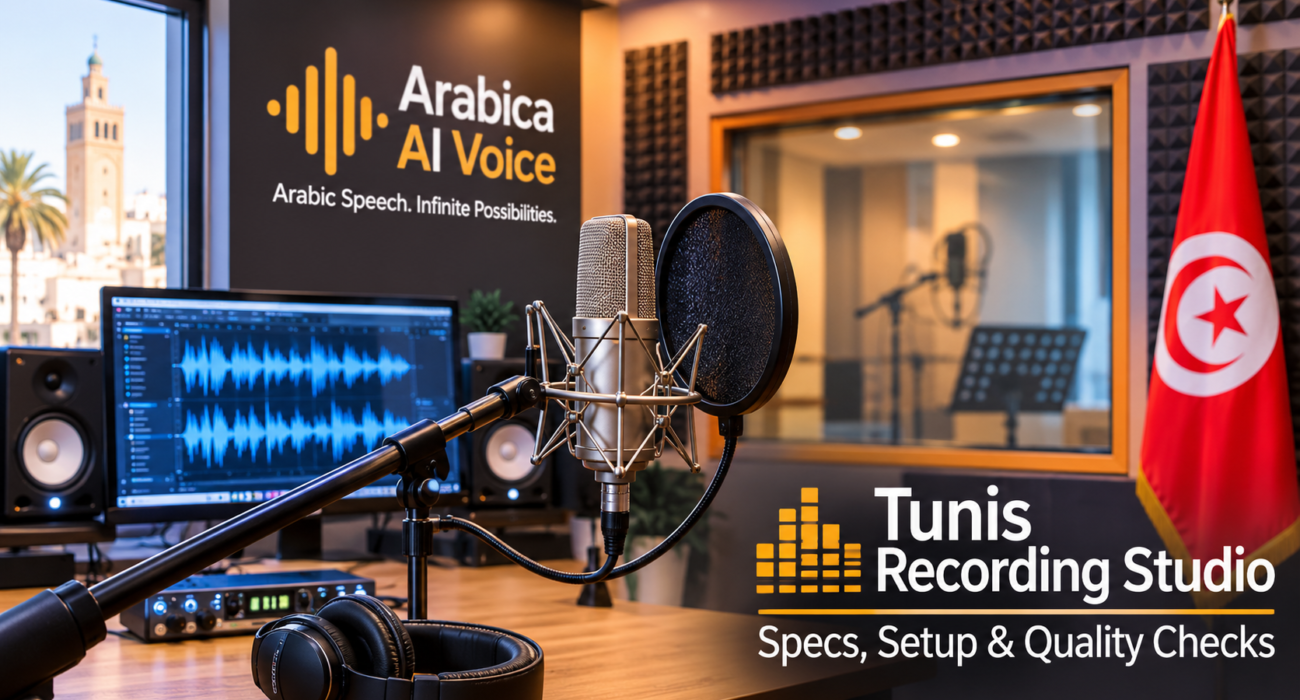
High-quality voice AI starts with high-quality audio. Behind every reliable Arabic speech recognition, transcription, and voice technology system is a recording process designed to capture speech as clearly and naturally as possible.
1. Why Recording Quality Matters for Arabic Voice AI
Speech recognition systems learn from audio examples. If recordings contain excessive background noise, inconsistent microphone levels, distortion, or unclear pronunciation, these problems can affect the quality of the resulting datasets.
This is particularly important for Arabic speech technologies. Arabic includes multiple dialects, regional accents, pronunciation variations, and speaking styles. A dataset must preserve these differences rather than introduce recording problems that make speech harder to understand.
Our recording approach focuses on three essential principles:
- Clarity: Capturing voices with minimal background noise and unwanted interference.
- Consistency: Maintaining stable recording conditions across speakers and sessions.
- Authenticity: Preserving natural pronunciation, rhythm, intonation, and dialect characteristics.
These principles help create audio datasets that are useful for speech recognition, automatic transcription, voice analysis, and other Arabic AI applications.
2. Inside Our Tunis Recording Studio
Our Tunis recording environment is organized to support controlled voice capture and repeatable recording sessions. The setup combines acoustic preparation, professional audio equipment, and a structured recording workflow.
2.1. Acoustic Environment
The recording environment is one of the most important elements of audio production. Even an excellent microphone cannot fully compensate for excessive room reflections, echo, or external noise.
Our studio setup prioritizes a controlled acoustic environment designed to reduce unwanted reflections and improve voice intelligibility.
Depending on the recording configuration, acoustic control can include:
- Acoustic panels to reduce reflections.
- Sound-absorbing materials to control room reverberation.
- Careful microphone positioning to capture direct speech.
- Noise management to limit interference from external sources.
- Consistent positioning of speakers and recording equipment.
The goal is not to make every voice sound artificially identical. It is to capture each speaker clearly while preserving the natural characteristics of their voice.
2.2. Microphones and Audio Capture
Microphone selection directly affects the quality and consistency of recorded speech. For voice dataset production, the equipment must capture speech accurately without introducing unnecessary coloration or distortion.
A professional recording configuration typically considers:
- Microphone type: Condenser microphones are commonly used for detailed voice capture in controlled environments.
- Polar pattern: Cardioid microphones can help focus on the speaker while reducing sound from other directions.
- Microphone distance: Consistent positioning helps maintain stable volume and tonal characteristics.
- Pop filters: These help reduce plosive sounds caused by certain consonants.
- Microphone stands: Stable positioning minimizes handling noise and unwanted movement.
Our equipment choices are guided by the requirements of the recording project, the type of speech being captured, and the desired dataset specifications.
2.3. Audio Interfaces and Recording Software
Microphones need a reliable signal path to convert acoustic speech into digital audio. Audio interfaces and recording software are therefore essential parts of the studio setup.
A typical recording chain includes:
- The microphone captures the speaker’s voice.
- The audio interface converts the analog signal into digital audio.
- Recording software captures and monitors the audio signal.
- Recorded files are exported using the required technical specifications.
- Audio files are reviewed before being transferred to the dataset workflow.
Throughout this process, gain levels are carefully monitored to avoid clipping, distortion, and unnecessarily low recording levels.
3. Recording Specifications and Technical Standards
Consistent technical specifications make audio datasets easier to process, analyze, annotate, and integrate into AI training pipelines.
Recording requirements can vary depending on the project. However, several technical parameters are particularly important for speech data.
3.1. Sample Rate
The sample rate determines how many audio samples are captured per second. A common professional speech recording standard is 48 kHz, while 16 kHz is frequently used for speech recognition workflows.
Recording at a higher sample rate can preserve additional audio information and provide flexibility during post-production. The final sample rate should always match the technical requirements of the target application.
3.2. Bit Depth
Bit depth determines the resolution of each digital audio sample. Recording at 24-bit provides greater dynamic range and additional headroom during recording and processing.
For professional voice capture, 24-bit recording is a useful choice because it allows engineers to manage recording levels while maintaining sufficient audio detail.
3.3. Audio Format
Uncompressed WAV files are commonly preferred for speech dataset production because they preserve the original audio signal without lossy compression.
Depending on the project, audio delivery requirements may include:
- WAV format for uncompressed audio.
- Mono recordings for individual speakers.
- Consistent sample rates across the dataset.
- Consistent bit depth.
- Standardized file naming conventions.
3.4. Recording Level and Signal Quality
Recording levels must be high enough to capture speech clearly but low enough to prevent digital clipping.
Our quality approach considers several indicators:
- Peak levels and clipping detection.
- Background noise levels.
- Signal-to-noise ratio.
- Unexpected volume variations.
- Distortion and unwanted interference.
These checks help identify technical problems before recordings move to the next production stage.
4. Our Recording Workflow
A reliable studio requires more than good equipment. It also needs a repeatable workflow that ensures every recording session follows consistent procedures.
4.1. Preparation Before Recording
Before each session, the recording environment and equipment are checked. Microphone placement, audio interface settings, recording software, and input levels are reviewed.
Speakers also receive instructions about the recording task, speaking distance, and expected delivery style.
For Arabic voice recordings, these instructions may include guidance on dialect, pronunciation, speaking pace, and natural delivery.
4.2. Speaker Recording Sessions
During recording, the speaker follows the assigned script or conversational prompts. Depending on the project, recordings may include:
- Modern Standard Arabic speech.
- Tunisian Arabic and other regional dialects.
- Natural conversational expressions.
- Formal and informal speaking styles.
- Different speaking speeds and intonation patterns.
Our approach aims to capture realistic speech rather than overly artificial performances. This is especially important when developing datasets intended to represent real-world Arabic communication.
4.3. File Organization and Documentation
After recording, audio files are organized according to project requirements. Clear naming conventions and structured metadata make it easier to identify speakers, sessions, recording conditions, and associated transcripts.
Depending on the project, metadata may include:
- Speaker identifier.
- Recording session identifier.
- Language or dialect category.
- Recording task or prompt identifier.
- Audio file reference.
- Associated transcription information.
Well-organized files reduce confusion and support efficient data processing and annotation.
5. Quality Checks: How We Evaluate Every Recording
Quality assurance is an essential part of our recording process. A recording may sound acceptable during a quick listen but still contain technical or linguistic issues that affect its usefulness for AI training.
We therefore use a structured quality control approach that considers both audio characteristics and recording content.
5.1. Background Noise Inspection
Background noise can make speech difficult to recognize, particularly when the recording contains low-volume words or subtle pronunciation differences.
We check for unwanted sounds such as:
- Air conditioning and ventilation noise.
- Traffic and environmental sounds.
- Computer fans and electrical interference.
- Microphone handling noise.
- Room echoes and excessive reverberation.
5.2. Clipping and Distortion Detection
Clipping occurs when an audio signal exceeds the maximum digital level that can be represented. This creates distortion and can damage important speech information.
We inspect waveform peaks and listen to recordings to identify clipping, distortion, and other signal problems.
5.3. Speech Intelligibility
Technical quality alone is not enough. The recorded speech must also be understandable.
Listening checks help identify:
- Incomplete or missing words.
- Unclear pronunciation.
- Unexpected interruptions.
- Incorrect reading or skipped content.
- Long silences or unintended speech overlaps.
When a recording does not meet the required standard, it can be flagged for review or re-recording.
5.4. Consistency Across Recording Sessions
Consistency is particularly important when building large speech datasets involving multiple speakers and recording sessions.
We monitor recording parameters such as microphone distance, input gain, audio format, and sample rate to minimize unnecessary technical differences.
At the same time, we preserve natural variations in accent, pronunciation, voice characteristics, and speaking style because these differences are valuable for Arabic AI development.
6. Why Arabic Dialect Representation Matters
Arabic is not a single uniform spoken language. It includes Modern Standard Arabic and numerous regional dialects, each with distinctive vocabulary, pronunciation, and linguistic patterns.
In Tunisia, everyday communication frequently involves Tunisian Arabic, which has its own expressions, phonetic characteristics, and conversational structures.
For speech AI systems, these differences create important challenges. A model trained primarily on formal Arabic may struggle to recognize spontaneous dialectal speech.
Our Tunis recording environment provides an opportunity to capture authentic Arabic speech in a controlled setting while respecting the linguistic diversity of speakers.
Depending on project requirements, recordings can support:
- Arabic automatic speech recognition (ASR).
- Speech-to-text applications.
- Dialect recognition and classification.
- Arabic conversational AI.
- Voice technology research and development.
The objective is to create useful, consistent, and representative speech data without losing the characteristics that make each Arabic variety unique.
7. From Studio Recordings to AI-Ready Datasets
Recording is only the beginning of the data production process. Once audio files pass the initial quality checks, they can move into additional processing stages.
Depending on the project, these stages may include:
- Audio validation: Checking file integrity and technical specifications.
- Segmentation: Dividing recordings into appropriate audio segments when required.
- Transcription: Converting spoken content into written text.
- Annotation: Adding linguistic or speaker-related labels according to project guidelines.
- Quality review: Checking transcription accuracy and alignment with the audio.
- Dataset preparation: Organizing approved files for downstream AI workflows.
This structured process helps transform raw recordings into reliable resources for speech technology development.
8. Our Commitment to Recording Quality
At Arabic AI Voice, we believe that reliable Arabic voice AI depends on the quality of the data behind it. Every recording environment, microphone position, technical setting, and quality check contributes to the final result.
Our Tunis recording studio is part of a broader approach focused on capturing authentic Arabic speech, supporting dialect diversity, and maintaining consistent audio standards.
Whether a project requires Modern Standard Arabic, Tunisian Arabic, or other regional varieties, a structured recording and quality assurance process provides a strong foundation for building useful speech datasets.
Conclusion
A professional recording studio is not simply a room equipped with microphones. It is a controlled production environment where acoustic conditions, technical specifications, recording procedures, and quality assurance work together.
Inside our Tunis recording studio, these elements support the creation of clear, consistent, and authentic Arabic speech recordings. By combining careful audio capture with structured quality checks, we aim to contribute to better datasets and more reliable Arabic voice AI technologies.
Because better Arabic AI starts with better Arabic audio.
Frequently Asked Questions (FAQ)
Where is the Arabic AI Voice recording studio located?
Our recording studio is based in Tunis, Tunisia, and supports voice recording projects focused on Arabic speech and language technology.
What audio format is best for speech AI datasets?
Uncompressed WAV is commonly used because it preserves audio quality without lossy compression. The sample rate, bit depth, and channel configuration depend on the requirements of each project.
Why is acoustic treatment important for voice recording?
Acoustic treatment helps reduce unwanted reflections and reverberation, making speech recordings clearer and easier to process.
Can a recording studio capture different Arabic dialects?
Yes. A controlled recording environment can support multiple Arabic varieties, including Modern Standard Arabic, Tunisian Arabic, and other regional dialects, while preserving their natural linguistic characteristics.
How do you ensure recording quality?
Quality checks can include background noise inspection, clipping detection, speech intelligibility review, technical specification validation, and consistency checks across recording sessions.
How are studio recordings used in Arabic AI development?
Studio recordings can be transcribed, segmented, annotated, and organized into datasets used for speech recognition, voice analysis, conversational AI, and other Arabic language technology applications.
“`