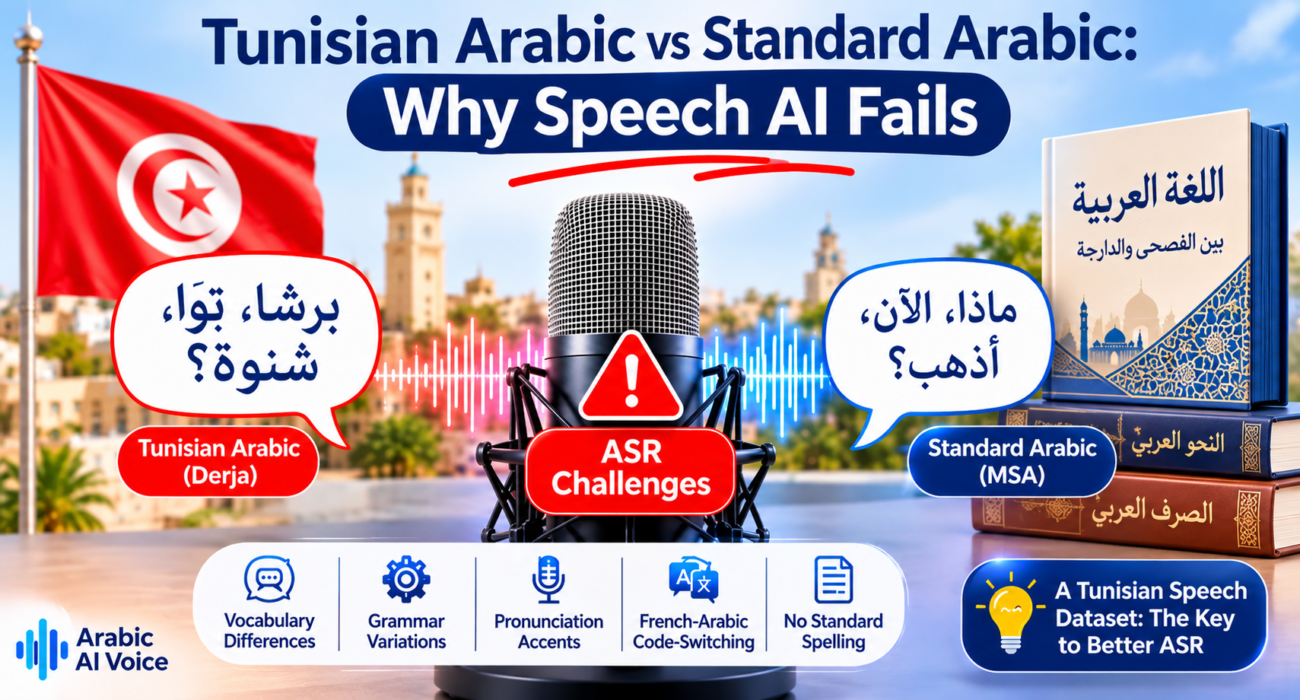
Two Languages in One Country
Tunisia, like the rest of the Arab world, lives with two forms of Arabic. Modern Standard Arabic is used for writing, the news, official documents and formal speeches. Tunisian Arabic, called Tounsi or Derja, is what about 12 million people speak at home, at work, in shops and on the phone.
Linguists call this situation diglossia. For speech AI it has a simple consequence: most written Arabic text, and much of the recorded speech used to train models, is Standard Arabic. But customers calling a bank, a telecom operator or an insurer in Tunisia speak Tounsi.
Five Differences That Break Speech Recognition
1. Vocabulary
Many everyday words have nothing in common with their Standard Arabic equivalents. “A lot” is برشا (barsha) in Tunis, not كثيرًا. “Now” is توّا (tawwa), not الآن. “What” is شنوة (chnouwa), not ماذا. A model that has never heard these words cannot transcribe them, however good its acoustic modelling is.
2. Grammar
Tunisian Arabic follows Maghrebi grammar. The first person singular uses an n- prefix: نمشي (nemchi) means “I go”, where Standard Arabic would say أذهب. Negation wraps around the verb: ما نحبّش (ma nhebbech), meaning “I don’t want”. These patterns confuse models that expect Standard Arabic word forms.
3. Pronunciation
Short vowels are often dropped, which creates consonant clusters that Standard Arabic does not allow. Words are shorter and faster. Regional accents add more variation: speech in the capital, the Sahel coast and the south does not sound the same.
4. French–Arabic Code-Switching
Tunisians switch between Arabic and French inside the same sentence, sometimes inside the same phrase:
“Ena mouch disponible lyoum, nkallmek ba3d la réunion.”
(“I’m not available today, I’ll call you after the meeting.”)
A model trained on one language at a time either drops the French words or forces them into Arabic spelling. We explain this in more detail in an upcoming article on code-switching.
5. No Standard Spelling
Tounsi has no official written form. The same word can be written in Arabic script in several ways, or in Latin letters with numbers (Arabizi, such as 3aslema for “hello”). Without clear transcription rules, training data becomes inconsistent and error rates rise.
What the Numbers Say
The gap is measurable. In Cohere’s published benchmark for its Transcribe model, the word error rate on North African Arabic was 36.9%, meaning roughly one word in three was wrong. Large players are now moving on Maghrebi dialects: in September 2026, Mistral AI and Morocco released a speech recognition model for Moroccan Darija. Demand for North African dialect data is growing, and Tunisian Arabic is still under-resourced.
What a Tunisian Speech Dataset Needs
Adding “more Arabic” does not solve the problem. A useful Tunisian ASR dataset needs:
- Native speakers from several regions (Greater Tunis, the Sahel, Sfax, the north-west and the south), with a balance of age and gender.
- Spontaneous speech, not only read sentences: conversations, customer-service style calls, short answers, hesitations.
- Real code-switching, with French segments transcribed and tagged, not removed.
- Consistent transcription rules, written by a linguist and applied by trained native transcribers, with quality checks at several levels.
- Rich metadata: speaker region, age range, gender, recording conditions and domain.
- Documented consent: every speaker signs an agreement that allows the recordings to be used for AI training, in line with GDPR.
How Arabic AI Voice Helps
Arabic AI Voice collects, transcribes and annotates Arabic dialect speech for AI, starting with the Maghreb. We record in our studio in Tunis and in the field, with consented native speakers. Transcription and annotation are led by native linguists, following dialect-specific guidelines.
You can read our technical specifications (formats, metadata and delivery) and our transcription conventions.
An off-the-shelf Tunisian Arabic dataset is in preparation. For custom collection, we recommend starting with a pilot.
Building speech AI for Tunisian users?
Contact us to discuss a pilot or request a sample.
Frequently Asked Questions
Is Tunisian Arabic the Same as Standard Arabic?
No. Tunisians understand Standard Arabic, but everyday Tunisian Arabic differs in vocabulary, grammar and pronunciation, and it mixes in many French words.
Can a Standard Arabic Speech Model Understand Tunisian?
Only partly. Error rates on North African Arabic stay high unless the model is trained or fine-tuned on native dialect recordings.
How Much Tunisian Speech Data Does a Model Need?
It depends on the use case. Fine-tuning an existing multilingual model on a specific domain needs far less data than training from scratch. A pilot is the best way to measure the gain before scaling up.
Is the Data Collected with Consent?
Yes. Every speaker signs a consent agreement before recording, and the data is handled in line with GDPR.