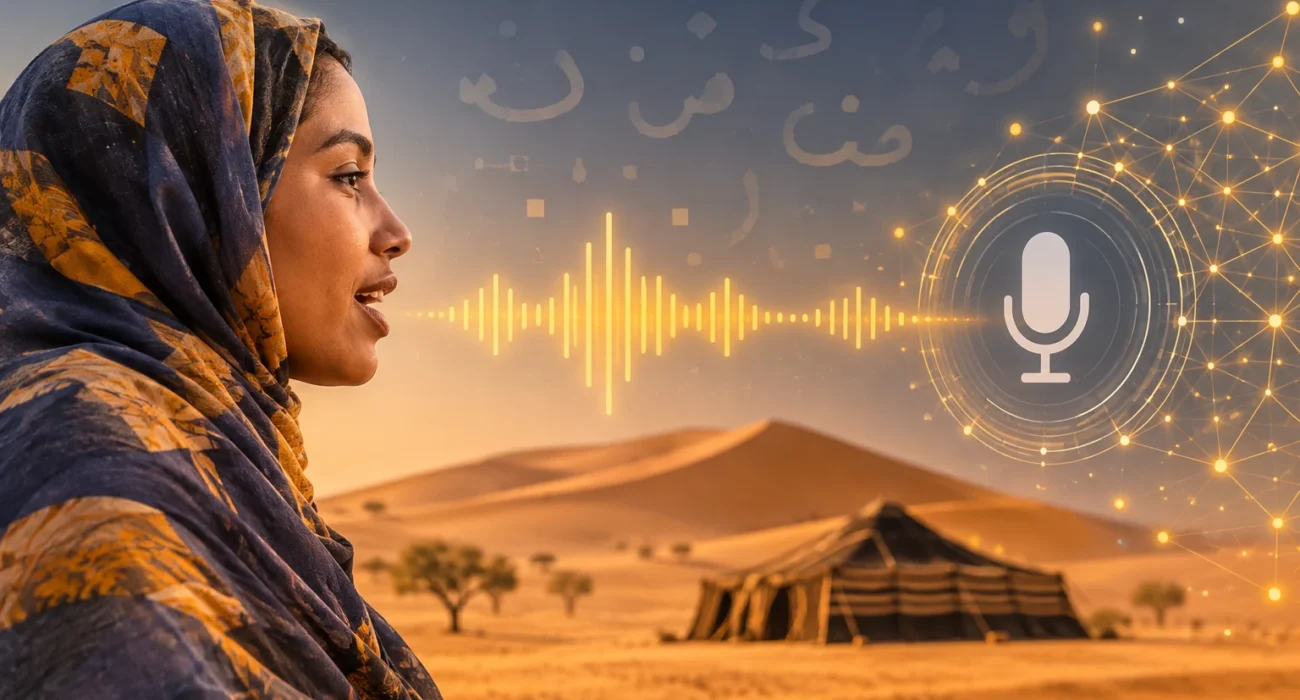
The results can be very different.
Hassaniya Arabic is a distinctive Arabic variety with its own vocabulary, pronunciation patterns and linguistic characteristics. Despite its importance to millions of speakers, it remains significantly less represented in digital language resources and speech technology than major Arabic varieties.
For companies developing speech recognition, conversational AI, voice assistants and other language technologies, this creates an important challenge: How can AI systems accurately understand a dialect when they have limited access to authentic recordings of the people who speak it?
In this article, we explore the linguistic characteristics of Hassaniya Arabic, the challenges it creates for Automatic Speech Recognition (ASR), and why high-quality, annotated speech datasets are essential to improving AI performance.
What Is Hassaniya Arabic?
Hassaniya Arabic is a dialect that developed in the western Sahara region and is primarily associated with Mauritania and Sahrawi communities.
It is also spoken in parts of Western Sahara, southern Morocco, southwestern Algeria, northern Mali and other areas of the Sahel.
The dialect developed through centuries of linguistic and cultural contact. Its foundations are rooted in Arabic, particularly the historical varieties associated with the Banu Hassan tribes, while its evolution also reflects Amazigh and other regional linguistic influences.
Hassaniya has preserved numerous classical Arabic expressions while developing distinctive vocabulary, grammatical structures and pronunciation patterns.
Unlike Modern Standard Arabic (MSA), which is primarily used in formal writing, education, news and official communication, Hassaniya is mainly used in everyday conversations, social interactions, storytelling and oral cultural traditions.
This distinction is particularly important for speech AI.
A model trained primarily on formal Arabic texts and recordings cannot automatically be expected to understand the natural speech patterns of Hassaniya speakers.
Five Linguistic Challenges for Hassaniya Speech Recognition
Developing reliable ASR systems for Hassaniya requires more than adapting an existing Arabic speech model. Several linguistic characteristics make this dialect particularly challenging.
1. Distinctive Vocabulary
Hassaniya contains vocabulary and expressions that differ from those commonly found in Modern Standard Arabic and other Arabic dialects.
Some words retain older Arabic forms, while others reflect centuries of contact with neighbouring languages and cultures.
Everyday expressions, local terminology and region-specific vocabulary may not appear frequently in conventional Arabic training datasets.
As a result, speech recognition models can struggle to identify unfamiliar words, particularly when they are pronounced naturally and used in spontaneous conversations.
A model may recognize the general meaning of a sentence while incorrectly transcribing several important words.
This becomes especially problematic in applications involving customer service, voice search, transcription and conversational assistants.
2. Pronunciation and Phonetic Variation
Hassaniya has distinctive pronunciation patterns that separate it from many other Arabic varieties.
Differences in consonant articulation, vowel realization, rhythm and intonation can influence how speech recognition systems interpret spoken words.
Regional variations also contribute to the complexity.
A speaker from Nouakchott may have different pronunciation characteristics from a speaker in rural Mauritania or a Sahrawi community.
These variations are natural features of the language, but they require speech recognition systems to learn from a sufficiently diverse range of native speakers.
Without representative recordings, models may perform well on a limited group of speakers while producing significantly less accurate results in real-world conditions.
3. Grammatical and Structural Differences
Although Hassaniya shares its linguistic foundations with Arabic, its grammatical structures and everyday sentence patterns have evolved differently from Modern Standard Arabic.
Verb forms, expressions, sentence construction and conversational structures can differ depending on context and regional usage.
For an ASR system, recognizing individual sounds is only part of the task.
The model must also understand how words relate to one another and how sentences are naturally constructed.
When the training data does not adequately represent Hassaniya grammar, the system may replace dialectal expressions with more familiar Standard Arabic forms or generate incorrect sentences.
This is one reason why dialect-specific language data is essential for improving transcription quality.
4. Multilingual Influences and Code-Switching
Hassaniya speakers live in multilingual environments where communication can involve several languages.
Depending on the region and speaker, conversations may include Arabic alongside French, Amazigh languages, Pulaar, Soninke or Wolof.
This linguistic diversity can create code-switching situations in which speakers move between languages within the same conversation.
For example, a professional conversation may combine Hassaniya expressions with French technical or administrative vocabulary.
An ASR model trained exclusively on Arabic speech may incorrectly transcribe foreign-language words, omit them entirely or replace them with Arabic equivalents.
To handle these situations effectively, training datasets should include authentic multilingual conversations rather than artificially separating each language.
5. Limited Standardization of Written Hassaniya
Another important challenge is the absence of a universally adopted writing standard for everyday Hassaniya.
Although Arabic script is widely used, spelling conventions can vary between writers, communities and publications.
The same spoken word may therefore appear in different written forms.
This creates difficulties when preparing transcription datasets for machine learning.
For example, two native transcribers may correctly understand the same recording but write a particular expression differently.
If these variations are not addressed through clear transcription guidelines, the resulting dataset may contain inconsistencies that negatively affect model training and evaluation.
A reliable Hassaniya speech dataset therefore needs documented orthographic conventions developed with native speakers and linguistic specialists.
Why Is Hassaniya Arabic Under-Represented in Speech AI?
The development of modern speech recognition systems depends heavily on the availability of large, diverse and accurately annotated datasets.
For widely supported languages, developers can access thousands of hours of recordings, public speech corpora, subtitles, podcasts and other digital resources.
For less digitally represented dialects such as Hassaniya, obtaining equivalent resources is considerably more difficult.
Several factors contribute to this situation.
- Limited recorded speech resources: There are fewer publicly accessible, professionally transcribed Hassaniya recordings compared with major Arabic varieties. This restricts the amount of high-quality material available for training and benchmarking ASR models.
- Insufficient regional diversity: A dataset collected from a limited number of speakers or locations cannot adequately represent the linguistic diversity of Hassaniya communities.
- Inconsistent transcription practices: Different writing conventions make it difficult to establish reliable audio-to-text pairs for supervised machine learning.
- Limited dialect-specific evaluation: Without dedicated test datasets, developers cannot accurately determine how well a model performs on Hassaniya compared with other Arabic varieties.
- Limited availability of specialized linguistic expertise: Accurate transcription requires people who understand the dialect, its regional variations and its natural conversational structures.
These challenges are not unique to Hassaniya. Research on Arabic speech recognition has repeatedly identified limited annotated data, dialectal variation and non-standardized orthography as important obstacles to improving recognition performance.
What Recent Research Tells Us
The development of Arabic speech technology is progressing, but dialect coverage remains uneven.
Recent research initiatives are beginning to address this problem through more detailed dialect identification and speech dataset development.
One example is CARDAMOM, a micro-dialectal Arabic speech dataset introduced in 2026. It contains approximately 40 hours of transcribed YouTube speech covering 21 micro-dialects across several countries, including Mauritania.
The research evaluates multilingual ASR systems and demonstrates how dialect-specific adaptation can improve recognition performance. The strongest zero-shot system reported an aggregate Word Error Rate (WER) of 43.47%, while adaptation reduced the aggregate rate to 35.21%.
Importantly, these figures cover the dataset’s evaluated micro-dialects collectively. They should not be interpreted as Hassaniya-specific performance results.
The project nevertheless highlights an important point: country-level Arabic labels can hide substantial linguistic differences between local communities.
For Hassaniya, this means that identifying Mauritanian Arabic as a single category may not be sufficient. Speech datasets need to account for regional and community-level variations.
The broader research direction is clear: more representative speech data, detailed dialect labels and reliable human annotation are essential for developing better Arabic speech recognition systems.
What Does a High-Quality Hassaniya Speech Dataset Need?
Building an effective Hassaniya ASR system starts with collecting the right data.
Simply increasing the amount of generic Arabic speech will not solve the problem. Training datasets must reflect how native Hassaniya speakers actually communicate.
A high-quality dataset should include the following elements:
1. Native Speakers from Different Regions
Recordings should represent speakers from different geographical areas and communities, including:
- Nouakchott and other urban areas in Mauritania.
- Rural Mauritanian communities.
- Sahrawi communities.
- Relevant Hassaniya-speaking communities in neighbouring regions.
The dataset should also include a balanced representation of age groups, genders and speaking styles.
2. Natural and Spontaneous Conversations
Reading prepared sentences is useful for certain speech recognition tasks, but it does not fully represent everyday communication.
A comprehensive dataset should include:
- Natural conversations between native speakers.
- Informal discussions and interviews.
- Customer service interactions.
- Questions and short responses.
- Storytelling and personal narratives.
- Spontaneous speech containing pauses, repetitions and hesitations.
These recordings help models learn how people actually speak rather than how they read prepared text.
3. Accurate Audio Transcription
Every recording intended for supervised ASR training should be associated with an accurate transcription.
Native speakers and trained transcribers should work with clearly documented transcription guidelines.
The process should account for dialect-specific vocabulary, pronunciation, sentence structure and spelling variations.
Where necessary, uncertain expressions should be reviewed rather than automatically replaced with Standard Arabic equivalents.
4. Multilingual and Code-Switching Annotation
The dataset should preserve the natural use of other languages within Hassaniya conversations.
French expressions and other language segments should be transcribed and identified appropriately.
This allows AI models to learn how speakers naturally move between languages without losing important information.
5. Detailed Speaker Metadata
Metadata provides important context for training, testing and evaluating speech recognition models.
Each recording should include relevant information such as:
- Speaker region.
- Age range.
- Gender, where appropriate and consented.
- Recording environment.
- Audio quality.
- Conversation type.
- Language and dialect labels.
- Code-switching information.
This information helps developers identify performance differences between speakers, regions and recording conditions.
6. Documented Consent and Data Protection
Ethical data collection is essential when recording human voices.
Every participant should receive clear information about the project and provide documented consent before recording.
The collection process should define how recordings are stored, accessed, processed and used for AI development.
Where applicable, data collection and processing should comply with GDPR and other relevant data protection requirements.
How Arabic AI Voice Can Support Hassaniya Speech AI
At Arabic AI Voice, we focus on collecting, transcribing and annotating Arabic dialect speech for artificial intelligence applications, with a particular interest in under-represented varieties across the Maghreb.
Hassaniya represents an important opportunity to expand the linguistic coverage of Arabic speech technologies.
Developing reliable datasets for this dialect requires a structured approach that combines native speaker recruitment, high-quality audio recording, accurate transcription and detailed linguistic annotation.
Our approach focuses on several essential stages:
- Speaker recruitment: Identifying native speakers representing the target dialect and regional variations.
- Audio collection: Recording natural speech in controlled studio environments and suitable field conditions.
- Transcription: Producing accurate transcripts based on dialect-specific linguistic guidelines.
- Annotation: Adding relevant metadata, speaker information and language identification.
- Quality control: Reviewing recordings and transcripts to maintain consistency and accuracy.
- Data delivery: Preparing structured datasets according to the technical requirements of AI developers.
You can explore our technical specifications to learn more about available formats, metadata and delivery requirements.
You can also consult our transcription conventions for additional information about our approach to Arabic dialect transcription.
For organizations developing speech recognition systems, conversational AI or multilingual voice applications, a pilot collection can be an effective first step toward evaluating the potential of Hassaniya speech data.
Conclusion: Better Speech AI Starts with Better Dialect Data
Hassaniya Arabic is an important part of the linguistic landscape of North Africa and the wider Sahara region.
Yet its representation in speech technology remains limited compared with more widely supported Arabic varieties.
The challenge is not simply teaching AI models to recognize more Arabic words. It is providing them with authentic recordings that reflect the vocabulary, pronunciation, grammar and natural communication patterns of Hassaniya speakers.
As speech AI becomes increasingly integrated into customer service, education, healthcare and digital communication, supporting under-resourced dialects will become essential to making these technologies more inclusive and accurate.
Building a speech recognition or conversational AI solution that needs Hassaniya Arabic?
Contact Arabic AI Voice to discuss your speech data requirements, explore a pilot collection or request a sample.
Frequently Asked Questions
What is Hassaniya Arabic?
Hassaniya Arabic is a dialect spoken primarily in Mauritania and by Sahrawi communities, with speakers also found in parts of Western Sahara, southern Morocco, southwestern Algeria and the Sahel region. It has distinctive vocabulary, pronunciation and grammatical characteristics.
Is Hassaniya Arabic the same as Modern Standard Arabic?
No. Although both share Arabic linguistic foundations, Hassaniya differs from Modern Standard Arabic in vocabulary, pronunciation, grammar and everyday expressions. Modern Standard Arabic is mainly used in formal communication, while Hassaniya is primarily used in daily conversations.
Why is Hassaniya difficult for AI speech recognition?
Hassaniya presents several challenges, including limited annotated speech data, regional pronunciation differences, dialect-specific vocabulary, variable spelling conventions and multilingual code-switching.
Models trained primarily on Standard Arabic may therefore struggle to produce accurate Hassaniya transcriptions.
Are there speech datasets for Hassaniya Arabic?
Research and dataset development are beginning to include Mauritanian Arabic varieties. For example, the CARDAMOM dataset includes Mauritanian micro-dialect speech. However, broader and more specialized resources are still needed to represent Hassaniya speakers, regional variations and everyday communication accurately.
How much Hassaniya speech data is needed to train an ASR model?
The required quantity depends on the model architecture, target application and available pretrained resources.
Fine-tuning an existing multilingual speech recognition model generally requires less data than training a new model from scratch.
A pilot dataset can help measure baseline performance, identify weaknesses and estimate the amount of additional data needed.
Can Hassaniya Arabic be used to train multilingual AI models?
Yes. Properly transcribed and annotated Hassaniya recordings can support multilingual ASR systems, dialect identification and other speech AI applications.
Including Hassaniya alongside other Arabic varieties can help models better understand the linguistic diversity of Arabic-speaking communities.
Why is native-speaker transcription important?
Native speakers understand local vocabulary, pronunciation, expressions and conversational context. Their expertise helps produce more accurate transcripts and reduces the risk of replacing authentic dialect expressions with incorrect Standard Arabic equivalents.