Imagine someone in Tunisia saying:
“El réunion mta3 ghodwa, nbadlouha wala nkhaliwha kif ma hiya?”
Or someone in Algeria saying:
“Rani f la voiture, n’arrivais pas à l’heure.”
And a Moroccan speaker saying:
“Khassni n’envoyer le document aujourd’hui.”
These sentences may sound perfectly natural to millions of North African speakers. They combine Arabic dialects with French vocabulary, expressions, and grammatical structures in a single conversation.
This linguistic phenomenon is known as French–Arabic code-switching.
For humans, understanding these sentences is usually straightforward. However, for Automatic Speech Recognition (ASR) systems, this mixture creates a significant technical challenge.
Many speech recognition models are trained primarily on Modern Standard Arabic, French, or other languages separately. When they encounter a speaker who switches between Arabic and French within the same sentence, their accuracy can decrease considerably.
So why is French–Arabic code-switching such a difficult problem for speech AI in North Africa, and what does it take to solve it?
1. What Is French–Arabic Code-Switching?
Code-switching occurs when a speaker alternates between two or more languages or linguistic varieties during a conversation.
In North Africa, this often involves switching between French and a local Arabic dialect, such as:
- Tunisian Arabic (Tounsi).
- Algerian Arabic (Darja).
- Moroccan Arabic (Darija).
Unlike formal language switching, which may happen between separate sentences, code-switching frequently occurs within a single sentence or even a short expression.
For example:
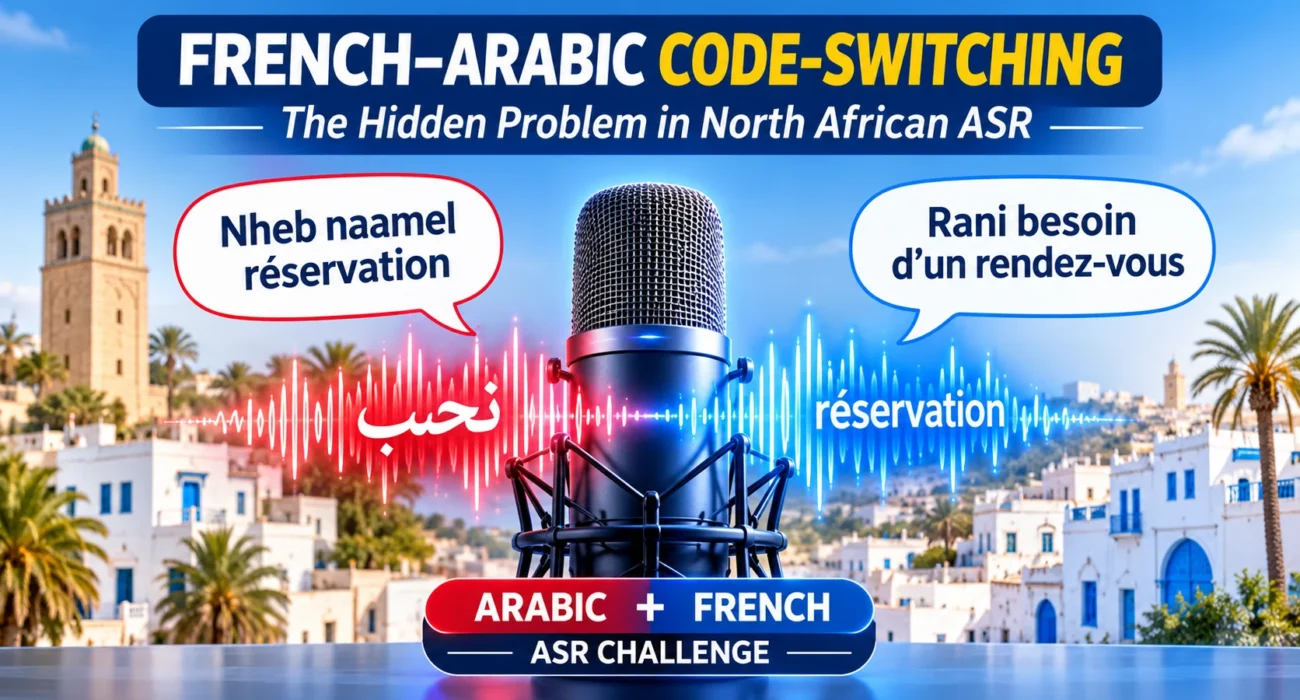
- Tunisian: “Nheb naamel réservation pour demain.”
- Algerian: “Rani besoin d’un rendez-vous.”
- Moroccan: “Bghit n’annuler le rendez-vous.”
A speaker may use Arabic for the sentence structure, French for professional vocabulary, and local expressions to communicate naturally.
This is not incorrect language use. It is a normal feature of everyday multilingual communication.
2. Why Is Code-Switching So Common in North Africa?
The widespread use of French alongside Arabic in North Africa has historical, educational, professional, and cultural roots.
French remains present in several areas of daily life, particularly in Tunisia, Algeria, and Morocco.
Education and professional environments
French is used in various educational institutions, technical fields, administrative environments, and professional sectors.
As a result, people frequently use French terminology even when speaking primarily in Arabic.
For example:
- “El projet mazal ma kamelch.” – The project is not finished yet.
- “B3athli le fichier.” – Send me the file.
- “Nheb nconfirmi le rendez-vous.” – I want to confirm the appointment.
Technology and digital communication
Digital communication has also strengthened this linguistic mixture.
People naturally integrate French words when discussing:
- Websites and applications.
- Marketing campaigns.
- Online payments.
- Professional meetings.
- Technical support.
- Social media.
A Tunisian might say:
“El site ma yekhdemch, fama problème fel serveur.”
This sentence combines Tunisian Arabic with French technical vocabulary.
For an ASR system, recognizing the individual words is only part of the challenge. It must also understand how they fit together.
3. Why French–Arabic Code-Switching Is Difficult for ASR Systems
Automatic Speech Recognition converts spoken language into written text. Although modern systems can recognize multiple languages, multilingual North African speech introduces several additional challenges.
3.1. Language identification within a single sentence
Traditional multilingual recognition systems often perform best when the language remains relatively consistent throughout an audio recording.
However, North African speakers may switch languages several times within a few seconds.
Consider this example:
“El client a demandé une modification fel page principale.”
The sentence contains:
- Tunisian Arabic: “El client” and “fel”.
- French: “a demandé une modification”.
- English technical terminology: “page”.
An ASR model must identify these language boundaries without interrupting the transcription process.
If it incorrectly identifies the language of a particular word, the resulting transcription may become inaccurate or incomplete.
3.2. French words pronounced with Arabic accents
French vocabulary does not always retain its original pronunciation when integrated into North African speech.
Speakers may adapt French sounds to the phonetic characteristics of their local Arabic dialect.
For example, a French word may be pronounced differently depending on the speaker’s region, accent, and speaking habits.
This creates difficulties for acoustic models trained primarily on standard French pronunciation.
A system may recognize a word correctly when pronounced by a native French speaker but fail to identify the same word when pronounced within a Tunisian or Algerian sentence.
3.3. Different Arabic dialects and pronunciation patterns
North Africa does not have a single uniform spoken Arabic variety.
Tunisian, Algerian, and Moroccan Arabic have different vocabulary, pronunciation patterns, and grammatical structures.
Even when speakers use the same French word, the surrounding Arabic sentence may be completely different.
For example:
| Country | Example | Meaning |
|---|---|---|
| Tunisia | Nheb naamel réservation | I want to make a reservation |
| Algeria | Rani besoin d’un rendez-vous | I need an appointment |
| Morocco | Bghit n’annuler le rendez-vous | I want to cancel the appointment |
These examples illustrate how a French expression can be integrated into different Arabic sentence structures.
An ASR system designed for one dialect may therefore struggle with another.
3.4. The problem of Arabic transcription and spelling
Another important challenge is the absence of a single standardized writing convention for many spoken Arabic dialects.
Tunisian, Algerian, and Moroccan Arabic are commonly written using different approaches:
- Arabic script.
- Latin characters.
- Arabizi, which combines Latin characters and numbers.
- Informal phonetic spelling.
For instance, the Tunisian expression “Nheb naamel” can appear in Latin transliteration or in Arabic script.
The same spoken expression may therefore produce different written representations.
For speech recognition systems, this creates an additional problem: deciding how to represent spoken dialect vocabulary consistently.
4. Real Examples of French–Arabic Code-Switching in Everyday Conversations
To understand the challenge, it helps to examine situations where multilingual speech is particularly common.
Example 1: Customer service
“Bonjour, nheb n3ref win wasel el dossier mte3i.”
Meaning: Hello, I would like to know the status of my application.
An ASR model must recognize the French greeting, the Tunisian Arabic question, and the French-origin administrative vocabulary.
Example 2: Healthcare
“3andi rendez-vous demain avec le médecin.”
Meaning: I have an appointment with the doctor tomorrow.
This type of sentence is particularly relevant to healthcare applications, where accurate transcription of appointments, medical terminology, and patient requests is essential.
Example 3: Business communication
“El réunion reportée lel semaine prochaine, b3athli le nouveau planning.”
Meaning: The meeting has been postponed until next week. Send me the new schedule.
The sentence contains French professional vocabulary mixed with Tunisian Arabic grammatical structures.
Example 4: Technical support
“Ma najamtech na3mel login, l’application ta3tini erreur.”
Meaning: I couldn’t log in; the application gives me an error.
Technical terminology is frequently borrowed from French or English, making code-switching especially common in digital environments.
These examples demonstrate why ASR systems need to understand how people actually speak, rather than relying exclusively on formal language patterns.
5. Why Traditional ASR Training Data Is Not Enough
One of the biggest obstacles to improving North African speech recognition is the availability and quality of training data.
Many speech recognition datasets focus on:
- Modern Standard Arabic.
- Standard French.
- Carefully recorded speech.
- Monolingual conversations.
- Formal vocabulary and pronunciation.
However, everyday North African conversations are often multilingual, spontaneous, and highly contextual.
A model trained mainly on formal Arabic and standard French may not have enough examples to recognize sentences containing both languages.
The importance of real conversational datasets
To improve recognition accuracy, AI developers need audio recordings that reflect natural speaking habits.
An effective dataset should include:
- Native speakers from Tunisia, Algeria, and Morocco.
- Natural French–Arabic code-switching.
- Different regional accents and pronunciation patterns.
- Professional and informal conversations.
- Technical, medical, administrative, and everyday vocabulary.
- Accurate transcriptions aligned with the original audio.
- Different speaking speeds, recording environments, and audio qualities.
The objective is not simply to collect more recordings. It is to collect representative, diverse, and accurately annotated speech data.
6. How Can AI Speech Recognition Handle French–Arabic Code-Switching?
Improving multilingual ASR requires a combination of better datasets, acoustic modeling, language identification, and contextual understanding.
6.1. Train models on mixed-language speech
Instead of training separate models exclusively on Arabic and French, developers should include recordings where both languages appear naturally in the same sentence.
This allows models to learn how speakers move between languages without treating every language change as an error.
6.2. Improve dialect-specific language recognition
A robust ASR solution should account for differences between Tunisian, Algerian, and Moroccan Arabic.
Dialect identification can help the system interpret vocabulary, pronunciation, and sentence structures more accurately.
However, dialect recognition should not be treated as a substitute for recognizing French–Arabic code-switching. Both capabilities are necessary.
6.3. Use contextual language modeling
Context is essential when recognizing mixed-language speech.
For example, a word used in a medical conversation may have a different interpretation from a similar-sounding word in a technical discussion.
Language models can use surrounding words and conversational context to improve transcription quality.
6.4. Establish consistent transcription standards
Training datasets should follow clear transcription guidelines.
These guidelines should define:
- Whether French words retain their original spelling.
- How Arabic dialect expressions are represented.
- How Arabizi is handled.
- How repeated words and hesitations are transcribed.
- How speakers’ language changes are annotated.
Consistency makes datasets more useful for training, evaluation, and comparison.
6.5. Evaluate models using real North African speech
A model should not be considered accurate simply because it performs well on standard Arabic or French benchmarks.
Evaluation should include recordings from real Tunisian, Algerian, and Moroccan speakers.
Metrics such as Word Error Rate (WER) and Character Error Rate (CER) can help measure transcription quality.
However, evaluation protocols must also account for spelling variation, dialectal vocabulary, and multiple acceptable transcription conventions.
7. The Future of French–Arabic Speech Recognition in North Africa
As voice assistants, automated customer service, transcription tools, and conversational AI become more common, the ability to understand multilingual speech will become increasingly important.
In North Africa, successful voice technology must reflect the linguistic reality of its users.
A Tunisian customer should be able to speak naturally without changing their accent or avoiding French vocabulary.
An Algerian user should not have to reformulate a sentence simply because it contains both Arabic and French.
Likewise, Moroccan speakers should be able to communicate using their everyday dialect.
At Arabic AI Voice, the diversity of spoken Arabic represents an important consideration in building more natural and accessible Arabic voice experiences.
Improving Arabic speech recognition requires going beyond Modern Standard Arabic and recognizing the multilingual patterns that shape everyday communication.
Understanding How North Africans Actually Speak
French–Arabic code-switching is not an unusual linguistic exception. It is an everyday communication pattern across large parts of North Africa.
For humans, switching between Arabic and French is often effortless. For AI speech recognition systems, however, it introduces challenges involving pronunciation, language identification, dialect variation, vocabulary, and transcription standards.
The solution starts with better representation of real-world speech.
By developing diverse datasets, improving dialect awareness, and training models on naturally mixed-language conversations, AI developers can build ASR systems that better understand North African speakers.
The future of Arabic speech recognition will not depend only on understanding Arabic as it is written. It will depend on understanding Arabic as people actually speak it.