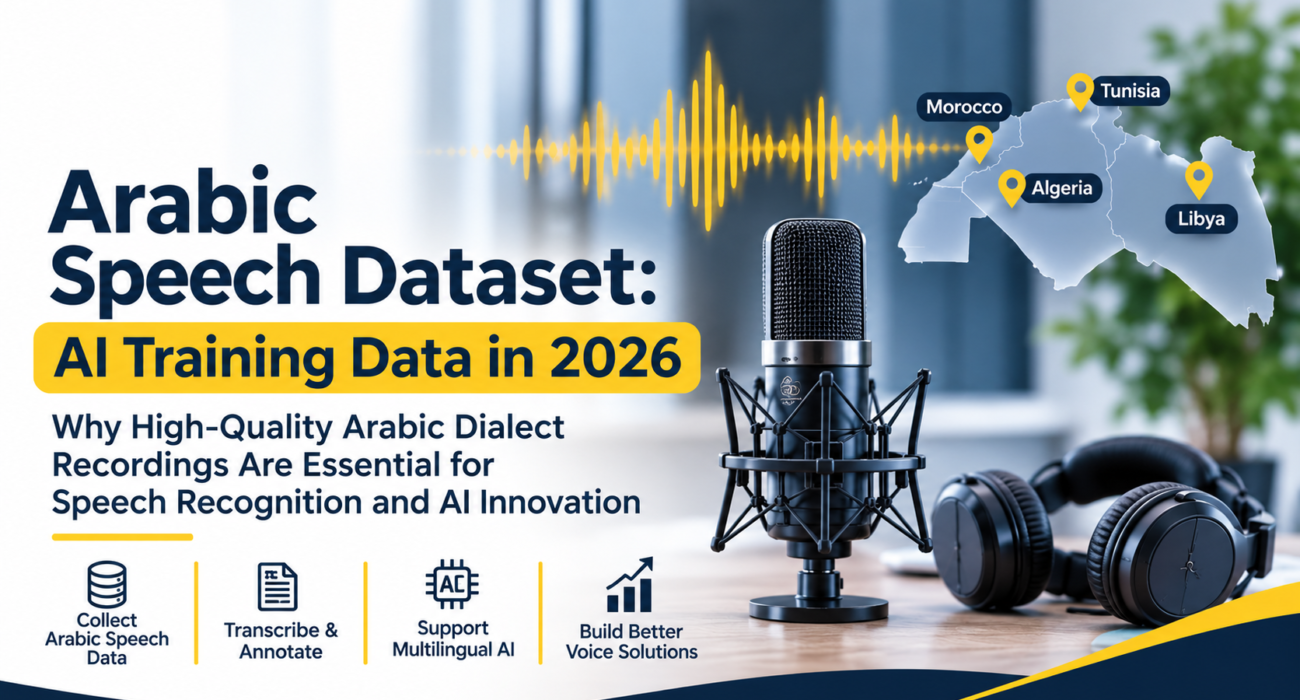
Artificial intelligence is transforming how people interact with technology. From voice assistants and automated customer service to speech recognition and conversational AI, voice-based applications are becoming an essential part of the digital ecosystem.
However, despite significant advances in artificial intelligence, one major challenge remains: understanding how people actually speak.
This challenge is particularly important for Arabic. Unlike languages with more standardized spoken forms, Arabic includes numerous regional dialects, pronunciation differences and everyday expressions that vary significantly from one country to another.
For AI developers, technology companies and machine learning researchers, access to high-quality Arabic speech datasets is becoming increasingly important.
In 2026, collecting authentic Arabic dialect recordings is not simply a data acquisition task. It is a strategic requirement for building more accurate, reliable and culturally relevant AI systems.
1. Why Arabic Speech Data Is Becoming More Important for AI
Speech recognition systems depend on large amounts of audio recordings to learn how people pronounce words, construct sentences and communicate in real-life situations.
Although Modern Standard Arabic (MSA) is widely used in formal communication, everyday conversations are different.
People in Tunisia, Algeria, Morocco, Libya, Egypt and Gulf countries use distinct dialects, expressions and pronunciation patterns.
A speech recognition model trained primarily on formal Arabic may struggle to understand:
- Regional vocabulary and colloquial expressions.
- Differences in pronunciation between Arabic dialects.
- Natural conversations involving multiple speakers.
- Background noise and real-world recording conditions.
- Conversations combining Arabic with French or English.
This creates a growing need for specialized Arabic speech datasets that reflect real communication patterns.
For companies developing speech recognition and conversational AI technologies, better training data can help improve model accuracy and usability.
2. Arabic Dialects: The Next Challenge for Speech Recognition
One of the most important developments in Arabic language technology is the growing recognition that Arabic should not be treated as a single uniform spoken language.
Each regional dialect presents specific linguistic characteristics.
Tunisian Arabic
Tunisian Arabic contains distinctive vocabulary, pronunciation and expressions influenced by several linguistic and cultural environments.
Everyday conversations frequently combine Tunisian Arabic with French, particularly in professional, commercial and urban contexts.
Algerian Arabic
Algerian Arabic includes regional variations and frequent interactions between Arabic, French and other local linguistic influences.
Libyan Arabic
Libyan Arabic has its own vocabulary, pronunciation and regional characteristics, making authentic local recordings particularly valuable for developing dialect-aware speech technologies.
Egyptian and Gulf Arabic
Egyptian Arabic has a strong presence in regional media, while Gulf Arabic is particularly relevant to applications targeting Saudi Arabia, the United Arab Emirates, Kuwait and other Gulf markets.
For AI developers, collecting recordings from native speakers is essential to capturing these linguistic differences.
3. French-Arabic Code-Switching: A Major Opportunity for AI Training
One of the most interesting challenges in North African speech technology is code-switching.
Code-switching occurs when speakers naturally alternate between two or more languages during the same conversation.
For example:
“غدوة عندي meeting مع ال client باش نكملو المشروع.”
This type of communication is common in Tunisia and other multilingual environments.
Traditional speech recognition systems may struggle with these conversations because they must identify language changes, understand mixed vocabulary and maintain accurate transcription.
High-quality Arabic-French speech datasets can help AI developers train models that better understand these natural linguistic patterns.
Such datasets are particularly relevant for:
- Multilingual voice assistants.
- Automated customer support.
- Speech-to-text applications.
- AI-powered call centres.
- Conversational AI platforms.
- Multilingual transcription systems.
4. What Makes a High-Quality Arabic Speech Dataset?
Not all audio recordings are suitable for training artificial intelligence models.
A professional Arabic speech dataset should combine linguistic accuracy, technical quality, reliable metadata and clear usage rights.
Several elements are particularly important.
Native Speaker Recordings
Recordings should come from native speakers who naturally use the target dialect.
This helps capture authentic pronunciation, vocabulary and conversational patterns.
Accurate Transcription
Each audio recording should be accompanied by a transcription reviewed by native Arabic speakers.
For dialectal recordings, transcription guidelines must account for colloquial vocabulary and language mixing.
Speaker Diversity
Datasets should include speakers from different regions, age groups and genders to improve linguistic diversity.
Audio Quality and Technical Specifications
Depending on the intended application, recordings may require specific sampling rates, formats, segmentation and noise conditions.
Structured Metadata
Useful metadata can include:
- Speaker identification.
- Dialect and regional origin.
- Recording duration.
- Age group and gender.
- Recording environment.
- Language-switching information.
- Quality assurance status.
Consent and Data Protection
Commercial AI training requires appropriate permissions and clearly documented data usage rights.
Organizations should ensure that recordings are collected transparently and that contributors understand how their voices and recordings may be used.
5. The Growing Demand for Arabic Speech Data Collection
As conversational AI and speech recognition technologies evolve, developers increasingly need datasets that represent real-world linguistic diversity.
This creates opportunities for specialized Arabic speech data collection providers.
Rather than relying exclusively on generic multilingual datasets, AI companies can work with local teams to collect recordings that meet specific technical and linguistic requirements.
Potential applications include:
Automatic Speech Recognition (ASR)
Training models that convert spoken Arabic into accurate written text.
Voice Assistants
Developing assistants capable of understanding regional dialects and natural conversations.
Conversational AI
Improving the ability of AI systems to understand customer requests and respond appropriately.
Automated Transcription
Creating reliable transcription solutions for Arabic audio, interviews, meetings and customer interactions.
Multilingual AI Systems
Supporting communication involving Arabic, French and English within the same conversation.
6. Why the Maghreb Is an Important Market for Arabic Speech Datasets
North Africa represents an important opportunity for speech technology development.
Tunisia, Algeria and Libya have distinctive dialects and multilingual communication patterns that deserve greater representation in AI training datasets.
In particular, Tunisian Arabic offers an interesting use case because everyday conversations frequently combine Arabic and French.
For technology companies developing AI solutions for North African markets, access to authentic local recordings can help address linguistic gaps that generic Arabic datasets may not adequately cover.
Building datasets directly within the countries where dialects are spoken also makes it possible to capture regional diversity and natural communication patterns.
7. How Arabic AI Voice Supports Speech Data Collection Projects
Arabic AI Voice focuses on collecting authentic Arabic dialect speech data and preparing it for AI development projects.
With a Maghreb-first approach, the company supports organizations looking for specialized Arabic speech data collection, transcription and annotation services.
Its services include:
- Arabic Speech Data Collection: Scripted, prompted and conversational recordings from native speakers.
- Transcription and Annotation: Dialect-native transcription, speaker identification and code-switching labels.
- Arabic Language Services: Translation verification, linguistic quality control and AI output evaluation.
- Image Data Collection: Image collection and annotation for AI applications.
Projects can be customized according to dialect, recording duration, speaker profiles, technical requirements and intended AI application.
The approach combines local recruitment, native linguistic review, quality assurance and documented contributor consent.
For organizations developing speech recognition systems, voice assistants or multilingual AI solutions, this approach provides a way to obtain structured and relevant Arabic language data.
8. The Future of Arabic Speech Recognition
The future of voice-based artificial intelligence will depend not only on more advanced algorithms but also on the quality and diversity of the data used to train them.
Arabic dialects, multilingual conversations and regional pronunciation patterns represent important challenges for developers.
As AI applications expand across the Middle East and North Africa, access to authentic Arabic speech recordings will become increasingly valuable.
Organizations that invest in representative, properly documented and linguistically accurate datasets will be better positioned to develop AI systems that understand how people really communicate.
Looking for Arabic Speech Data for Your AI Project?
Arabic AI Voice helps AI developers and technology companies collect, transcribe and annotate authentic Arabic dialect speech data.
Whether you need Tunisian, Libyan, Algerian or other Arabic dialect recordings, our team can help define a data collection project according to your technical specifications.
Request a free 30-minute sample and discuss your Arabic speech data requirements with our team.
Contact Arabic AI Voice
Frequently Asked Questions
What is an Arabic speech dataset?
An Arabic speech dataset is a structured collection of Arabic audio recordings, often accompanied by transcriptions and metadata, used to train and evaluate speech recognition and other AI models.
Why are Arabic dialect datasets important?
Arabic dialect datasets help AI systems understand regional pronunciation, colloquial vocabulary and natural speech patterns that may not be represented in standard Arabic datasets.
What is Tunisian Arabic speech data used for?
Tunisian Arabic speech data can support the development of voice assistants, speech recognition systems, automated transcription and conversational AI applications targeting Tunisian speakers.
What is Arabic-French code-switching?
Arabic-French code-switching refers to conversations in which speakers naturally alternate between Arabic and French. It is particularly common in Tunisia and other North African countries.
How is Arabic speech data collected?
Speech data is collected through scripted, prompted or conversational recordings from native speakers. Recordings are then reviewed, transcribed, annotated and organized according to project specifications.
Can Arabic speech datasets be used for commercial AI training?
Yes, provided the recordings have been collected and licensed with appropriate permissions for the intended commercial AI training purposes.