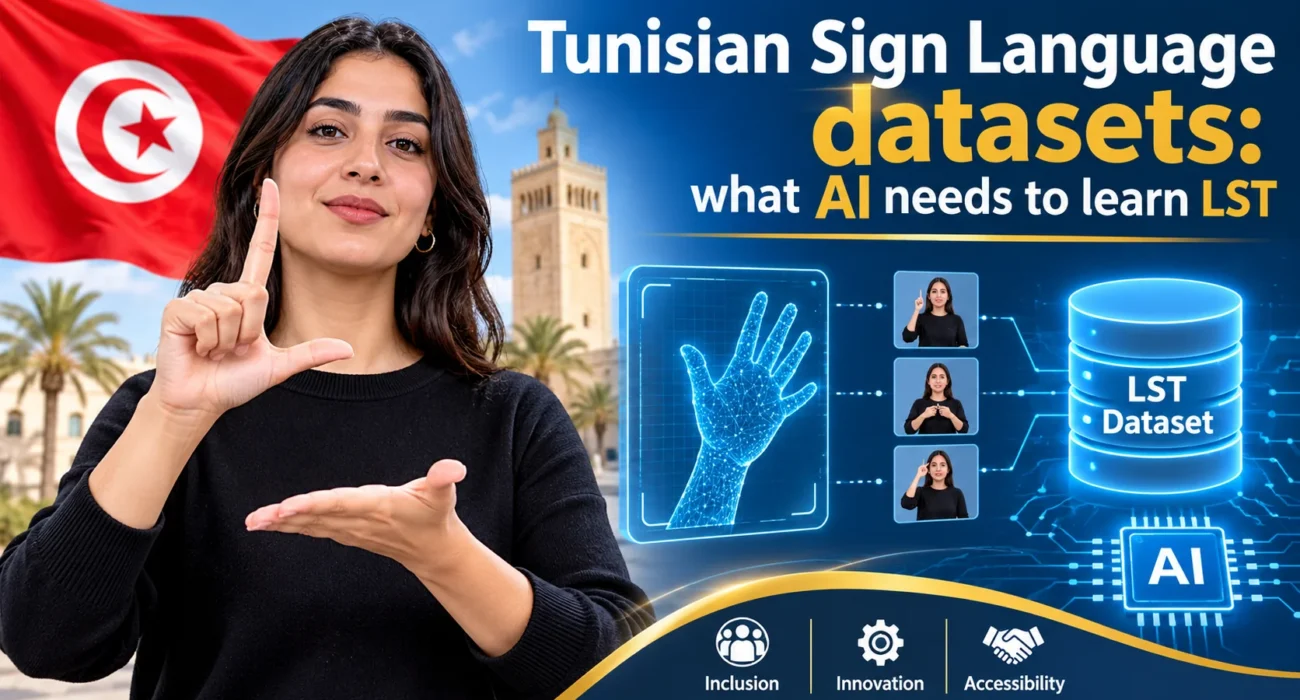
1. Why Tunisian Sign Language Needs Dedicated AI Datasets
Sign languages are complete linguistic systems with their own vocabulary, grammar, structures, and cultural characteristics. They are not simply visual representations of spoken languages. This distinction is essential when developing AI models designed to understand them.
Tunisian Sign Language has its own linguistic characteristics and is used within the Tunisian Deaf community. An AI model trained primarily on American Sign Language (ASL), British Sign Language (BSL), or another sign language cannot automatically understand LST.
Each sign language has specific hand configurations, movements, facial expressions, and grammatical patterns. Even when two languages share visually similar signs, their meanings and usage may differ.
Without dedicated LST datasets, AI developers face several limitations:
- Limited recognition of Tunisian signs and expressions.
- Difficulty understanding the grammatical structure of LST.
- Poor performance when encountering unfamiliar signers.
- Insufficient representation of regional and individual variations.
- Limited opportunities to develop practical translation applications.
Building dedicated datasets is therefore a fundamental step toward creating AI technologies that genuinely support the Tunisian Deaf community.
2. What Should a Tunisian Sign Language Dataset Contain?
A useful LST dataset should capture much more than isolated hand gestures. Sign language communication involves several visual and linguistic components that work together to convey meaning.
2.1. Hand Shapes and Configurations
Hand shape is one of the most important elements of sign language recognition. Different signs can involve different finger positions, hand orientations, and configurations.
An LST dataset should include videos showing:
- Different hand configurations.
- Finger positions and movements.
- Single-hand and two-hand signs.
- Changes in hand orientation.
- Signs with visually similar hand shapes.
These examples help computer vision models identify the visual characteristics that distinguish one sign from another.
2.2. Hand Movements and Spatial Information
Sign languages are dynamic. A sign may depend on the direction, speed, repetition, and trajectory of a movement.
For this reason, collecting individual images is not sufficient for building advanced LST recognition systems. Video sequences are necessary to capture how signs evolve over time.
Datasets should document:
- Movement direction and trajectory.
- Starting and ending hand positions.
- Movement speed and repetition.
- Interactions between both hands.
- Spatial relationships between signs.
Temporal information allows AI models to distinguish signs that may look similar in a single frame but have different movements and meanings.
2.3. Facial Expressions and Non-Manual Signals
One of the most important challenges in sign language AI is understanding that communication does not happen through the hands alone.
Facial expressions, eyebrow movements, eye gaze, head position, and body posture can contribute to grammatical structures and meaning.
For example, facial expressions may help distinguish questions, statements, emphasis, and other linguistic functions.
A comprehensive LST dataset should therefore capture the face and upper body, rather than focusing exclusively on hand movements.
2.4. Vocabulary and Linguistic Annotations
Visual recordings need reliable linguistic annotations to become useful training data.
Each video sequence should ideally include information such as:
- The corresponding sign or expression.
- Its linguistic meaning.
- Its beginning and ending timestamps.
- Its grammatical or contextual role when known.
- Relevant facial and body movements.
- Alternative forms and regional variations.
Annotations should be reviewed by people with appropriate LST expertise, including members of the Deaf community. This helps reduce labeling errors and improves linguistic accuracy.
3. The Main Challenges of Collecting LST Data
Creating a high-quality Tunisian Sign Language dataset involves technical, linguistic, and organizational challenges. These difficulties must be addressed before large-scale AI training can become reliable.
3.1. Limited Available Digital Resources
One major challenge for under-resourced sign languages is the availability of accessible, structured, and sufficiently diverse digital recordings.
Researchers may find individual videos, educational resources, or recordings of signed communication, but these materials do not necessarily form a machine-learning-ready dataset.
AI training requires consistent video quality, clear labels, organized metadata, and documented collection procedures.
3.2. Regional and Individual Variations
Like other natural languages, sign languages can include variations related to geography, age, social context, and individual signing styles.
LST datasets should account for these differences instead of assuming that every signer produces exactly the same visual representation of a sign.
Training data should include participants from different backgrounds and communication contexts to help models become more robust and inclusive.
3.3. Recording Conditions and Video Quality
Computer vision systems depend heavily on the quality of their visual input. Poor lighting, camera positioning, motion blur, and obstructed hands can make sign recognition more difficult.
A reliable data collection process should consider:
- Consistent lighting conditions.
- Clear visibility of the hands and face.
- Suitable camera angles and recording distances.
- High-resolution video recordings.
- Different backgrounds and realistic environments.
The dataset should contain controlled recordings for accurate annotation, as well as more natural recordings that reflect real communication situations.
3.4. Ethical Data Collection and Consent
Sign language datasets often contain identifiable videos of participants. This makes privacy and ethical data management particularly important.
Researchers must obtain informed consent and clearly explain how recordings will be stored, processed, shared, and used for AI training.
The Tunisian Deaf community should also participate in decisions about data ownership, access, representation, and future applications.
4. How AI Learns Tunisian Sign Language from Datasets
Once a dataset has been collected and annotated, machine learning models can begin learning the visual and temporal patterns associated with LST.
Different AI approaches can contribute to this process, depending on whether the goal is isolated sign recognition, continuous sign recognition, or translation.
4.1. Computer Vision and Hand Tracking
Computer vision algorithms analyze video frames to identify visual information such as hands, faces, body positions, and movement patterns.
Hand-tracking techniques can help extract keypoints representing finger joints, palm positions, and hand orientation.
These representations can reduce the complexity of visual data and provide useful inputs for machine learning models.
4.2. Deep Learning Models
Deep learning techniques can learn complex patterns directly from images, videos, or extracted visual features.
Convolutional Neural Networks (CNNs) can analyze spatial information in individual frames, while temporal models can learn how signs change over time.
Architectures such as Long Short-Term Memory networks (LSTMs), 3D CNNs, and Transformer-based models can be explored for recognizing sequences of signs.
The most appropriate architecture depends on the size and quality of the dataset, the complexity of the task, and the available computing resources.
4.3. From Sign Recognition to Continuous Translation
Recognizing a single sign is different from understanding an entire signed sentence.
An isolated sign recognition system identifies individual signs from short video clips. A continuous recognition system must identify sequences of signs without requiring clear pauses between them.
A complete LST translation system requires additional linguistic processing to understand context, grammatical relationships, and sentence-level meaning.
This distinction is important because translating sign language word by word does not necessarily produce accurate or natural communication.
5. Building a Practical Tunisian Sign Language Dataset
Developing an effective dataset requires a structured approach that combines linguistic expertise, technical resources, and community participation.
A possible development strategy includes the following stages:
Step 1: Define the Dataset Objectives
The first step is to determine what the dataset should support. Possible objectives include isolated sign recognition, continuous signing recognition, educational applications, or future translation systems.
Clearly defined objectives help determine the vocabulary, recording format, annotation requirements, and evaluation methods.
Step 2: Collaborate with the Deaf Community
Native and experienced LST signers should be involved throughout the project. Their participation is essential for identifying signs, validating meanings, documenting variations, and ensuring cultural relevance.
Linguists, sign language educators, researchers, and Deaf community organizations can contribute complementary expertise.
Step 3: Record Diverse Signing Examples
Video recordings should include multiple participants, different signing styles, and a wide range of vocabulary and communication contexts.
Each recording should follow consistent technical guidelines while preserving natural variations between signers.
Step 4: Annotate and Validate the Data
Every recording should receive appropriate labels and metadata. Annotation should include sign boundaries, vocabulary, relevant visual features, and contextual information when available.
Human review is essential to validate the annotations and resolve ambiguous examples.
Step 5: Train and Evaluate AI Models
The dataset can then be divided into training, validation, and testing subsets.
To avoid misleading evaluation results, recordings from the same signer should be carefully managed across these subsets. Testing with previously unseen signers can provide a more realistic assessment of model generalization.
Performance can be measured using metrics such as accuracy for isolated sign classification, and Word Error Rate (WER) or Sign Error Rate (SER) for sequence recognition tasks, where appropriate.
6. What Makes a High-Quality LST Dataset?
Dataset size is important, but the number of recordings alone does not determine quality. A smaller, carefully annotated dataset may provide more useful training signals than a larger collection containing inconsistent labels or duplicated examples.
A high-quality Tunisian Sign Language dataset should prioritize:
- Linguistic accuracy: Signs and meanings must be validated by qualified LST contributors.
- Signer diversity: Different participants and signing styles should be represented.
- Visual consistency: Recordings must provide sufficient visibility of hands, faces, and body movements.
- Temporal annotations: Sign boundaries and movement sequences should be documented.
- Contextual information: The dataset should support understanding beyond isolated gestures.
- Ethical accessibility: Data collection and sharing must respect participant consent and privacy.
- Reproducibility: Documentation should explain how recordings were collected, annotated, and evaluated.
7. Potential Applications of AI for Tunisian Sign Language
A well-developed LST dataset could support several applications designed to improve accessibility and communication.
7.1. Real-Time Sign Recognition
AI-powered applications could analyze camera recordings and recognize individual LST signs, helping users access digital tools that understand signed communication.
7.2. Educational Platforms
Digital learning platforms could use LST datasets to develop interactive exercises, visual learning tools, and automated feedback systems.
7.3. Accessibility in Public Services
Future systems could help improve access to information in public institutions, educational environments, and selected service contexts.
However, such applications should be carefully evaluated before deployment, especially in situations involving important personal, legal, or medical information.
7.4. Research and Language Preservation
Structured digital resources can also support linguistic research, documentation, and the preservation of LST knowledge for future generations.
This is particularly valuable for languages and communities that remain underrepresented in digital technologies.
8. The Future of Tunisian Sign Language in Artificial Intelligence
The future of Tunisian Sign Language AI depends on building strong foundations before focusing exclusively on advanced models.
More powerful algorithms cannot compensate for missing vocabulary, unreliable annotations, insufficient signer diversity, or a lack of linguistic understanding.
Progress requires long-term collaboration between AI researchers, computer vision specialists, linguists, educators, and the Tunisian Deaf community.
Open and responsibly governed datasets could also encourage research collaboration, improve reproducibility, and make it easier for developers to experiment with new recognition approaches.
The objective should not simply be to create a model that recognizes a collection of hand gestures. It should be to develop technology that respects the linguistic complexity of LST and supports real communication.
Better Data Is the Foundation of Better LST AI
Teaching artificial intelligence to understand Tunisian Sign Language begins with data. Before an AI model can recognize signs, interpret sequences, or support translation, it needs access to representative videos, reliable linguistic annotations, and diverse examples of natural signing.
Building dedicated LST datasets is therefore more than a technical challenge. It is an important step toward digital inclusion, language documentation, and accessible technology in Tunisia.
The future of LST in artificial intelligence will depend not only on the sophistication of machine learning algorithms but also on the quality of the data and the people involved in creating it.
Better datasets can lead to better recognition, more reliable applications, and AI systems that understand and respect Tunisian Sign Language.