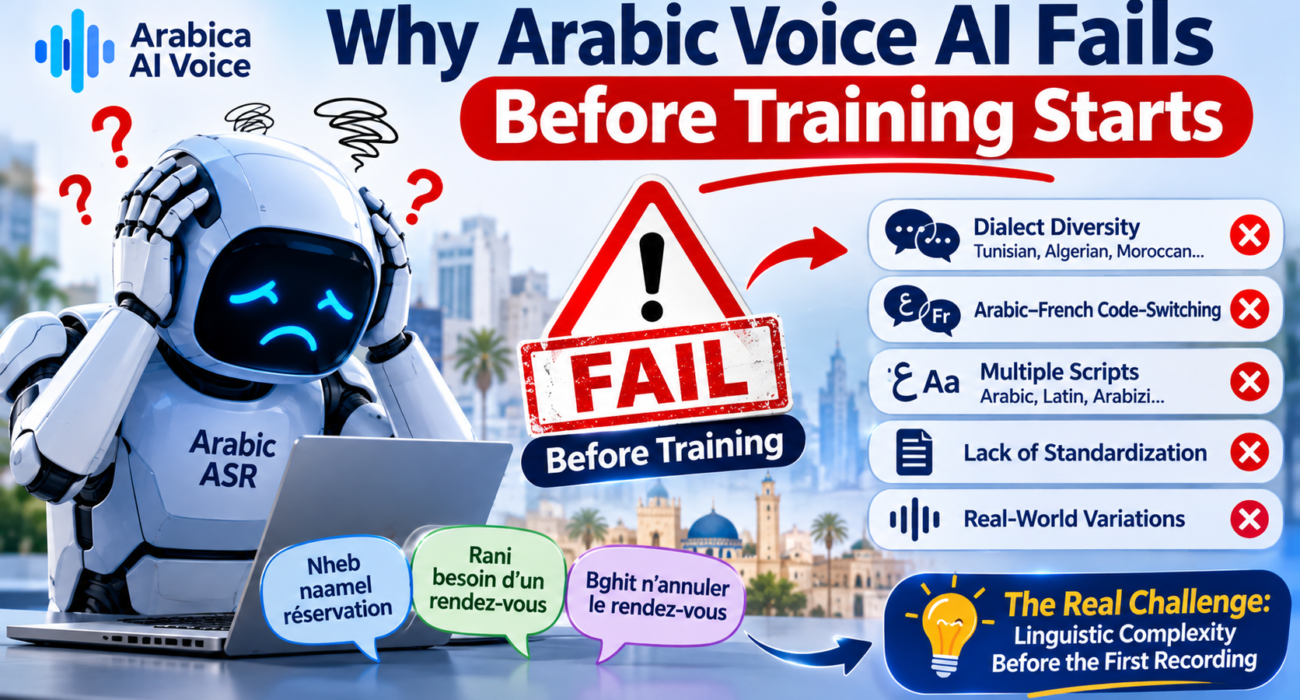
Building an accurate Arabic voice recognition system is not simply a matter of choosing a powerful AI model or increasing computing resources. In many cases, the biggest problems appear long before the first training session begins.
Arabic speech technology faces a unique set of challenges related to dialect diversity, pronunciation, writing systems, multilingual conversations, and speech data quality.
A model designed to recognize Modern Standard Arabic may perform well in formal recordings but struggle when exposed to everyday conversations in Tunisian, Algerian, Moroccan, or other regional Arabic dialects.
Why does this happen?
Because successful Arabic voice AI starts with something more fundamental than model architecture: understanding the language, defining the right data requirements, and preparing representative speech datasets.
In this article, we explore the main reasons why Arabic voice AI projects can fail before training even starts and what developers should consider to avoid these problems.
1. Arabic Is Not a Single Spoken Language
One of the first mistakes in Arabic speech AI development is treating Arabic as a single, uniform language.
Modern Standard Arabic (MSA) is widely used in formal communication, education, journalism, and official documents. However, everyday conversations are dominated by regional dialects.
These dialects have different vocabulary, pronunciation, grammatical structures, and expressions.
For example, the expression “I want” can vary considerably:
| Dialect | Expression | Meaning |
|---|---|---|
| Tunisian Arabic | Nheb (نحب) | I want |
| Algerian Arabic | Nhab (نحب) | I want |
| Moroccan Darija | Bghit (بغيت) | I want |
| Egyptian Arabic | 3ayez (عايز) | I want |
A speech recognition model trained primarily on Modern Standard Arabic may not recognize these expressions accurately.
Why does this create a problem?
Before collecting speech data, developers must determine which Arabic varieties the system needs to understand.
A project targeting Tunisian Arabic requires different linguistic resources from one targeting Gulf Arabic or Egyptian Arabic.
Without a clearly defined dialect strategy, the resulting dataset may not represent the actual users of the system.
The solution: Define the target dialects, geographical coverage, pronunciation variations, and intended use cases before starting data collection.
2. Dialect Diversity Is Often Underestimated
Arabic dialects are not simply different accents of the same vocabulary.
They can differ significantly in everyday expressions, sentence construction, and word pronunciation.
Consider the following expressions:
- Tunisian: “Chnowa taamel?” (شنوة تعمل؟)
- Algerian: “Wach rak dir?” (واش راك دير؟)
- Moroccan: “Ach katdir?” (أشنو كتدير؟)
All three expressions can be used to ask someone what they are doing.
However, their vocabulary and pronunciation are different.
For an AI speech recognition system, these variations create a major challenge.
A model needs enough representative examples to recognize different speakers, regional expressions, and pronunciation patterns.
The importance of regional representation
A dataset containing recordings from only one city or a small group of speakers may not adequately represent an entire dialect.
For example, Tunisian Arabic can vary between regions, and the same applies to Algerian and Moroccan Arabic.
Developers should consider:
- Regional vocabulary differences.
- Urban and rural pronunciation.
- Age-related language variations.
- Different speaking speeds.
- Formal and informal expressions.
- Natural conversational habits.
The objective is to build a dataset that reflects real linguistic diversity rather than an artificially uniform version of Arabic.
3. French–Arabic Code-Switching Creates Additional Complexity
In North Africa, many people naturally combine Arabic and French in the same conversation.
This phenomenon is known as code-switching.
It is particularly common in Tunisia, Algeria, and Morocco, where French vocabulary frequently appears in professional, educational, technical, and everyday communication.
Consider these examples:
Tunisian Arabic:
“El réunion mta3 ghodwa, nbadlouha wala nkhaliwha?”
Algerian Arabic:
“Rani besoin d’un rendez-vous.”
Moroccan Darija:
“Khassni n’envoyer le document aujourd’hui.”
These sentences combine Arabic dialects with French vocabulary and expressions.
For humans, understanding them is usually natural.
For an ASR system, however, identifying language changes within a single sentence can be difficult.
A model trained exclusively on Arabic or French recordings may struggle to recognize these mixed-language expressions.
What should developers consider?
Before training begins, project teams should determine whether code-switching is part of the target speech environment.
If it is, the dataset should include:
- Arabic–French mixed sentences.
- Different French pronunciation patterns.
- Dialect-specific grammatical structures.
- Technical and professional vocabulary.
- Natural conversations rather than only scripted sentences.
This helps ensure that the model is exposed to the way people actually communicate.
4. Inconsistent Arabic Writing Systems and Transcription
Another important challenge appears when spoken Arabic must be converted into written text.
Unlike English or French, many Arabic dialects do not have one universally adopted spelling convention.
Depending on the speaker and context, dialectal Arabic can be written using Arabic script, Latin characters, or Arabizi.
For example:
- Arabic script: نحب نمشي
- Latin transliteration: Nheb nemchi
- Arabizi: N7eb nemchi
These forms represent the same Tunisian expression: “I want to go.”
However, they are different written representations.
Why does transcription consistency matter?
Speech recognition models rely on training examples that connect audio recordings with written transcriptions.
If the same expression appears in several different spelling formats without clear annotation rules, the dataset can become inconsistent.
This creates difficulties during model training and evaluation.
Establishing transcription standards
Before collecting and annotating large volumes of audio, teams should define:
- The preferred writing system.
- How dialect vocabulary should be represented.
- Whether French words retain their original spelling.
- How Arabizi expressions are handled.
- How numbers and abbreviations are transcribed.
- How repeated words and incomplete sentences are represented.
A consistent transcription policy makes the dataset easier to manage, validate, and use.
5. Poor Speech Data Quality Can Affect the Entire Project
Even when the target dialect is clearly defined, poor recording quality can compromise the usefulness of a speech dataset.
A recording may contain accurate speech but still be unsuitable for a particular AI application.
Common problems include:
- Background noise.
- Echo and microphone interference.
- Low recording volume.
- Audio distortion.
- Incomplete sentences.
- Missing audio segments.
- Inconsistent recording formats.
For example, recordings collected using different mobile devices in uncontrolled environments may have significant differences in audio quality.
These variations are not necessarily bad. In fact, realistic audio conditions can be useful for certain applications.
However, they must be controlled and documented according to the project’s objectives.
Technical specifications must come first
Before recording begins, developers should define the required:
- Sampling rate.
- Audio bit depth.
- Recording format.
- Mono or stereo configuration.
- Maximum background noise level.
- Recording duration.
- Microphone requirements.
The specifications should reflect the intended application rather than being selected randomly.
A well-designed recording protocol helps reduce avoidable technical problems.
6. Recruiting the Wrong Speakers Leads to Weak Datasets
The quality of an Arabic speech dataset also depends on the people participating in the recording process.
Recruiting speakers without considering the project’s linguistic requirements can create an unrepresentative dataset.
For example, a project targeting Tunisian Arabic should not rely exclusively on speakers who primarily use Modern Standard Arabic or another regional dialect.
What makes a representative speaker profile?
Depending on the project’s objectives, recruitment criteria may include:
- Native or fluent dialect speakers.
- Different geographical regions.
- Different age groups.
- Gender representation.
- Different educational backgrounds.
- Bilingual Arabic–French speakers.
- Different professional backgrounds.
The exact selection criteria should be based on the intended users and the application.
Why speaker diversity matters
A speech recognition system must recognize more than one person’s pronunciation.
It should be exposed to natural differences in speaking styles, accents, vocabulary, and speech patterns.
A dataset containing many hours of recordings from only a few speakers may provide less linguistic diversity than a smaller but carefully designed collection involving a broader range of participants.
7. Missing Annotation Guidelines Create Problems Before Training
Speech annotation is another critical stage that should be planned before data collection begins.
Annotations provide additional information about recorded speech and help organize the dataset for machine learning applications.
Depending on the project, annotations may include:
- Exact spoken words.
- Speaker identification.
- Word-level timestamps.
- Sentence boundaries.
- Language identification.
- Dialect identification.
- Non-speech sounds.
- Background noise information.
Without clear guidelines, different annotators may interpret the same recording differently.
For example, one annotator may transcribe a Tunisian expression using Arabic script, while another uses Latin transliteration.
Even when both are linguistically understandable, the inconsistency can create problems for the dataset.
The importance of annotation documentation
Before annotation starts, project teams should establish:
- Transcription conventions.
- Dialect-specific vocabulary rules.
- Speaker labeling standards.
- Timestamp requirements.
- Code-switching annotation rules.
- Quality review procedures.
Clear guidelines improve consistency and reduce the need for extensive corrections later.
8. Insufficient Dataset Planning and Coverage
Another reason Arabic voice AI projects struggle is the absence of a clear data collection strategy.
Collecting a large quantity of recordings does not automatically produce a high-quality dataset.
A project may collect thousands of hours of audio but still lack important linguistic categories.
For example, it may contain:
- Too many recordings from one region.
- Insufficient representation of certain dialects.
- Limited French–Arabic code-switching.
- Few spontaneous conversations.
- Repetitive scripted sentences.
- Insufficient speaker diversity.
This is why dataset planning should focus on coverage and representativeness, not only recording volume.
Build a dataset coverage matrix
Before launching recruitment, developers can create a coverage matrix to identify the required categories.
| Dataset dimension | Examples |
|---|---|
| Language | Arabic, French, mixed speech |
| Dialect | Tunisian, Algerian, Moroccan |
| Speech type | Scripted, spontaneous, conversational |
| Accent | Regional pronunciation variations |
| Speakers | Different participant profiles |
| Environment | Studio, office, mobile |
| Vocabulary | Everyday, technical, medical |
This approach helps identify missing categories before they become expensive problems.
9. Privacy and Consent Must Be Considered from the Beginning
Speech recordings are not ordinary digital files.
A person’s voice may be identifiable, and recordings can contain personal or sensitive information.
Therefore, privacy and consent should be considered before participant recruitment and recording begin.
A responsible speech data collection project should define:
- The purpose of data collection.
- The intended use of recordings.
- The legal basis for processing personal data.
- Participant information and consent procedures, where consent is the applicable legal basis.
- Data storage and access controls.
- Data retention periods.
- Applicable withdrawal and deletion procedures.
- Rules for sharing recordings with authorized third parties.
For projects involving personal data, applicable regulations such as the GDPR or relevant national data protection laws must be considered.
These requirements should be integrated into the project design rather than added as an afterthought.
10. How to Prepare an Arabic Speech Dataset Before Training
A successful Arabic voice AI project requires a structured preparation process.
Before launching model training, teams should complete several important stages.
Step 1: Define the target application
Determine whether the project is intended for:
- Automatic Speech Recognition (ASR).
- Voice assistants.
- Speech-to-text applications.
- Call center automation.
- Voice search.
- Speech analytics.
- Text-to-Speech (TTS).
Each application may require different data characteristics.
Step 2: Identify target dialects
Determine which Arabic dialects and regional variations must be represented.
Avoid treating all Arabic speakers as a single linguistic category.
Step 3: Define recruitment criteria
Establish speaker profiles that reflect the intended audience.
Step 4: Establish recording protocols
Define audio specifications, recording environments, scripts, and spontaneous speech requirements.
Step 5: Create transcription and annotation guidelines
Ensure that all recordings follow consistent linguistic and technical standards.
Step 6: Implement quality control
Establish procedures for reviewing audio quality, transcription accuracy, annotation consistency, and dataset completeness.
Step 7: Validate dataset coverage
Check whether the collected recordings adequately represent the target dialects, speakers, and communication scenarios.
Step 8: Prepare the dataset for delivery and training
Organize audio files, transcriptions, annotations, metadata, and documentation into a structured package.
Only after these preparation stages should the dataset move into the model training workflow.
11. The Real Foundation of Arabic Voice AI
The success of Arabic voice technology depends on more than advanced algorithms.
It requires a deep understanding of how Arabic speakers communicate in real life.
Dialect diversity, code-switching, transcription conventions, recording quality, and speaker representation all influence the usefulness of the training data.
At Arabic AI Voice, Arabic linguistic diversity is an important consideration when exploring speech data and voice AI solutions.
Building better Arabic voice technology starts with asking the right questions:
- Which dialects are we targeting?
- Who are the speakers?
- How do they naturally communicate?
- Which languages do they combine?
- How will their speech be transcribed?
- Does the dataset reflect real-world communication?
These questions should be answered before the first recording is collected, not after a model fails to recognize the target speech.
Better Arabic Voice AI Starts Before Training
Arabic voice AI projects can encounter serious difficulties before model training even begins.
The underlying causes often involve insufficient dialect coverage, inconsistent transcription, limited speaker diversity, poor recording protocols, and inadequate dataset planning.
These problems cannot always be solved by choosing a more advanced model or increasing computing power.
The foundation must be built correctly from the beginning.
By defining linguistic requirements, recruiting representative speakers, establishing clear annotation standards, and implementing rigorous quality control, developers can create more useful and reliable Arabic speech datasets.
Better Arabic voice AI does not start with training. It starts with understanding the voices, dialects, and people behind the data.