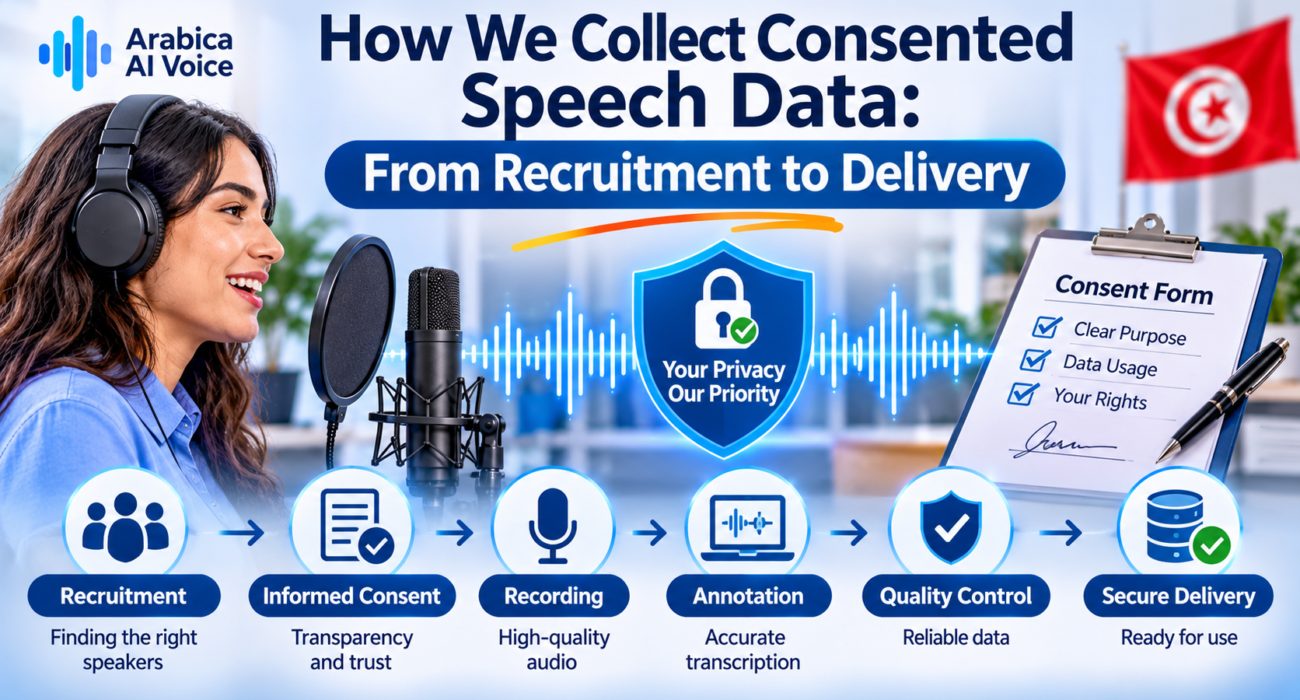
High-quality speech recognition systems do not start with algorithms alone. They start with real human voices.
Behind every reliable Automatic Speech Recognition (ASR) model is a collection of audio recordings that help artificial intelligence understand different accents, languages, pronunciation patterns, and speaking habits.
However, collecting speech data is not simply about recording people talking. It requires a structured process that respects participants’ rights, protects their personal information, and ensures that every recording meets clearly defined quality standards.
At Arabic AI Voice, consent and data quality are essential considerations when developing speech data collection projects.
From recruiting native speakers to validating recordings and delivering structured datasets, each stage plays an important role in building reliable speech AI solutions.
In this article, we explore how a responsible speech data collection workflow works, from the first participant interaction to the final dataset delivery.
1. Why Consent Matters in Speech Data Collection
Voice recordings contain more than spoken words. They may reveal personal information, communication habits, accents, and other characteristics that make a speaker recognizable.
This makes informed consent a fundamental requirement for responsible speech data collection.
Before recording begins, participants should understand exactly what they are agreeing to.
A transparent consent process should explain:
- Who is collecting the recordings.
- Why the speech data is being collected.
- How the recordings will be used.
- Whether the data will be used to train or evaluate AI models.
- Who may access the recordings.
- How long the data will be retained.
- Whether the recordings will be shared with third parties.
- How participants can exercise their applicable privacy rights.
Consent should be freely given, informed, specific, and documented.
Participants must also have a clear opportunity to ask questions before agreeing to take part.
Importantly, consent to participate in a recording project should not be treated as unlimited permission to use someone’s voice for any future purpose.
2. Participant Recruitment: Finding the Right Speakers
The first operational stage is recruiting participants who match the linguistic and demographic requirements of the project.
For Arabic speech datasets, recruitment is particularly important because Arabic is spoken in many regional varieties, each with distinctive vocabulary, pronunciation, and grammatical structures.
A dataset designed for Tunisian Arabic, for example, requires speakers who naturally communicate in Tunisian Arabic rather than relying exclusively on Modern Standard Arabic.
Defining recruitment requirements
Before launching recruitment, the project team establishes a participant profile.
Depending on the project, this may include:
- Native or fluent language speakers.
- Specific Arabic dialects and regional accents.
- Age groups, where relevant and lawfully collected.
- Gender representation, where relevant to the research objectives.
- Different levels of education or professional backgrounds.
- Urban and rural speech variations.
- French–Arabic or English–Arabic bilingual speakers.
These criteria help create a representative dataset rather than a collection of recordings from a narrow group of speakers.
Recruiting participants across North Africa
For multilingual Arabic projects, recruitment may cover several countries and regions.
Examples include:
- Tunisia: Tunisian Arabic (Tounsi).
- Algeria: Algerian Arabic (Darja).
- Morocco: Moroccan Arabic (Darija).
- Libya: Libyan Arabic.
Recruitment can take place through community networks, professional recruitment partners, language communities, and dedicated participant platforms.
The objective is to obtain authentic speech from people who naturally use the target language or dialect in their everyday lives.
3. Informed Consent: Explaining the Recording Process
Once potential participants have been identified, the next step is obtaining their informed consent.
This stage must happen before any recording covered by the consent agreement begins.
Participants should receive clear information in a language they understand.
What should a consent form include?
A well-designed consent form generally covers:
Project purpose: Why the recordings are being collected and what the project aims to achieve.
Recording activities: The type of speech participants will be asked to produce, including reading exercises, spontaneous conversations, or scripted dialogues.
Data usage: Whether recordings will be used for ASR training, speech synthesis, linguistic research, evaluation, or other specified purposes.
Privacy and security: How audio files and associated information will be stored, protected, and accessed.
Data sharing: Whether recordings may be shared with clients, research partners, or other authorized organizations.
Retention period: How long the recordings and associated information will be retained.
Participant rights: How participants can withdraw consent or exercise applicable data protection rights, subject to the relevant legal and contractual framework.
A clear consent process creates trust and helps ensure that speech data is collected responsibly.
4. Recording Speech Data: Capturing Natural Human Voices
After recruitment and consent, participants can move to the recording stage.
The objective is to collect clear, representative audio that reflects how people actually speak.
However, recording conditions can significantly affect the usefulness of a dataset.
Choosing the right recording environment
Depending on the project requirements, recordings may take place in:
- Professional recording studios.
- Quiet offices.
- Controlled home environments.
- Mobile recording setups.
The environment should minimize unwanted background noise, echo, and microphone interference.
Recording equipment and technical requirements
Audio specifications should be defined before recording begins.
Typical considerations include:
- Sampling rate.
- Audio bit depth.
- Mono or stereo recording.
- Supported audio formats, such as WAV.
- Microphone positioning.
- Recording duration.
- Background noise thresholds.
- Audio clipping and distortion.
The exact technical requirements depend on the intended AI application.
For example, a dataset intended for high-quality speech recognition training may require different recording conditions from one designed to evaluate voice recognition in noisy environments.
Reading scripts and spontaneous conversations
Speech data collection can involve different recording methods.
Scripted recordings
Participants read predefined sentences, paragraphs, or prompts.
This approach helps control vocabulary, pronunciation coverage, and linguistic structures.
Spontaneous speech
Participants speak naturally about everyday subjects.
This captures conversational expressions, hesitations, informal vocabulary, and natural pronunciation.
Conversational recordings
Two or more speakers participate in a structured dialogue.
This helps capture turn-taking, interruptions, and variations in speaking styles.
For North African Arabic projects, combining these methods can provide a more comprehensive representation of everyday communication.
5. Dialect Coverage and Linguistic Diversity
One of the biggest challenges in Arabic speech data collection is linguistic diversity.
Modern Standard Arabic is important for formal communication, education, and media. However, millions of Arabic speakers communicate primarily through regional dialects.
A dataset focused exclusively on formal Arabic may not adequately represent everyday speech.
Collecting regional Arabic varieties
A comprehensive North African speech dataset may include:
- Tunisian Arabic.
- Algerian Arabic.
- Moroccan Arabic.
- Libyan Arabic.
Each dialect should be treated as a distinct linguistic variety with its own vocabulary, pronunciation patterns, and grammatical characteristics.
Capturing code-switching
Another important consideration is multilingual speech.
In Tunisia, Algeria, and Morocco, speakers frequently alternate between Arabic and French.
For example:
“El réunion mta3 ghodwa, nbadlouha wala nkhaliwha?”
This sentence combines Tunisian Arabic with French vocabulary.
Capturing such expressions is particularly valuable for speech recognition systems designed for real-world multilingual conversations.
A representative dataset should therefore include natural code-switching when it is part of the project’s linguistic scope.
6. Transcription and Speech Annotation
Once recordings have been collected, the next stage is transcription and annotation.
This process converts spoken audio into structured information that can be used to train, validate, and evaluate AI models.
Audio transcription
Transcription involves converting recorded speech into written text.
For dialectal Arabic, this requires clear transcription guidelines because the same expression may be written in different ways.
For example, Tunisian Arabic can be represented using:
- Arabic script.
- Latin transliteration.
- Arabizi.
The project must establish a consistent writing convention before annotation begins.
Speaker identification
For multi-speaker recordings, each speaker should be assigned a consistent identifier.
This process, known as speaker diarization, helps identify who spoke and when.
Time alignment
Time alignment associates spoken words or sentences with their corresponding positions in the audio recording.
Depending on project requirements, annotations may include:
- Word-level timestamps.
- Sentence-level timestamps.
- Speaker labels.
- Language identification.
- Dialect identification.
- Background noise indicators.
- Non-speech events.
These annotations make datasets more useful for different speech AI applications.
7. Quality Control: Ensuring Reliable Speech Data
Collecting recordings is only part of the process.
Before a dataset can be delivered, it must undergo quality control.
The purpose is to identify recordings that do not meet the project’s technical, linguistic, or annotation requirements.
Audio quality checks
Audio files can be checked for:
- Excessive background noise.
- Distorted or clipped speech.
- Low recording volume.
- Missing audio segments.
- Incorrect file formats.
- Unexpected silence.
- Recording interruptions.
Transcription quality checks
Transcriptions should also be reviewed to identify:
- Missing words.
- Incorrect vocabulary.
- Spelling inconsistencies.
- Incorrect speaker labels.
- Timestamp errors.
- Misidentified dialect expressions.
Human validation
Automated tools can help detect technical issues, but human review remains important for dialectal speech.
Native or highly proficient speakers can identify linguistic errors that automated systems may overlook.
A quality assurance workflow may include first-pass annotation, independent review, discrepancy resolution, and final validation.
8. Data Privacy, Security, and Access Management
Speech data collection involves responsibilities that continue long after the recording session.
Audio files and associated metadata must be handled according to applicable privacy and data protection requirements.
A responsible workflow should include:
Secure storage: Protect recordings against unauthorized access, loss, or alteration.
Access control: Restrict access to authorized project personnel and approved partners.
Data minimization: Collect only the personal information necessary for the project.
Pseudonymization: Use participant identifiers instead of directly identifying information wherever possible.
Retention management: Define how long recordings and associated information are kept.
Deletion procedures: Establish processes for handling valid deletion or withdrawal requests in accordance with applicable obligations.
Voice recordings should not automatically be considered anonymous simply because a participant’s name has been removed. A voice can itself be identifying.
For projects involving European participants or organizations, GDPR requirements may apply. Other local data protection laws may also be relevant depending on where participants are recruited and where data is processed.
9. Dataset Preparation and Final Delivery
After transcription, annotation, and quality control, the dataset is prepared for delivery.
The final structure depends on the client’s technical requirements and intended application.
A speech dataset package may include:
Audio files
Original recordings organized according to the project’s naming and folder structure.
Common formats include WAV and other agreed audio formats.
Transcription files
Text files containing the corresponding spoken content.
Structured metadata may include:
- Speaker IDs.
- Language labels.
- Dialect labels.
- Word or sentence timestamps.
- Recording information.
- Quality control results.
Dataset documentation
Documentation helps clients understand the dataset and use it correctly.
It may include:
- Dataset description.
- Recording methodology.
- Participant recruitment criteria.
- Consent and permitted usage information.
- Audio technical specifications.
- Transcription guidelines.
- Annotation conventions.
- Quality assurance methodology.
- Known limitations.
Secure transfer
The final package can be delivered through an agreed secure transfer method.
Access permissions, delivery confirmation, and any applicable data processing documentation should be established before handover.
The goal is to provide a dataset that is organized, documented, validated, and ready for the client’s intended workflow.
10. From Human Voices to Better Arabic AI
Collecting speech data is a process that connects human communication with artificial intelligence.
For Arabic speech technology, the quality of this process is particularly important because regional dialects, accents, and multilingual expressions are not always adequately represented in conventional datasets.
A reliable speech data collection workflow requires more than recording equipment.
It requires:
- Carefully planned participant recruitment.
- Transparent and informed consent.
- Appropriate recording conditions.
- Representative linguistic coverage.
- Accurate transcription and annotation.
- Consistent quality control.
- Responsible privacy and security practices.
- Structured dataset delivery.
At Arabic AI Voice, the diversity of Arabic speech is an important consideration in developing more representative voice technology.
By focusing on consent, linguistic diversity, and data quality, speech data projects can contribute to AI systems that better understand how people communicate in real life.