Arabic is a language rich in expressions, cultural influences, and regional variations. One of the most interesting aspects of spoken Arabic is how different communities can express exactly the same idea using completely different words.
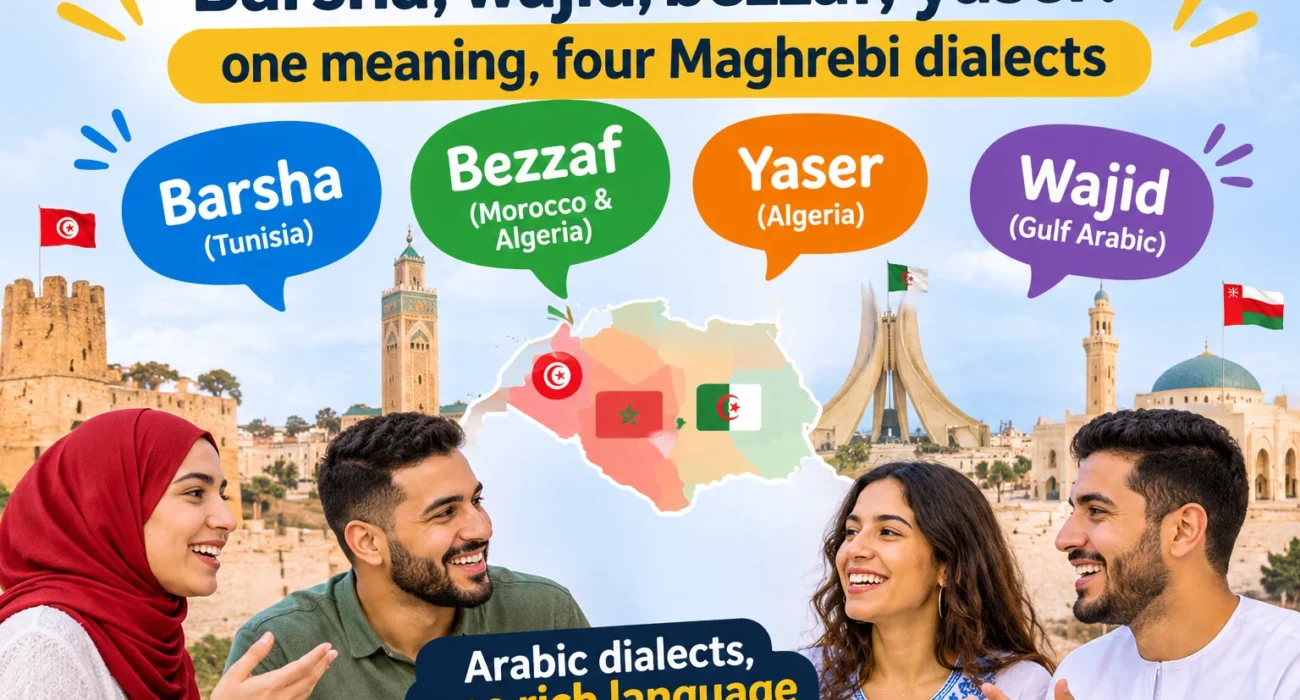
Take the expression “a lot” or “very much”. Depending on where you are in North Africa or the wider Arabic-speaking world, you might hear barsha, bezzaf, yaser, or wajid.
Although these expressions share a similar meaning, each one reflects a particular linguistic identity, regional history, and way of speaking.
In this article, we explore these four expressions, their meanings, their regional associations, and how understanding them can help you communicate more naturally with Arabic speakers.
1. Barsha (برشا): The Tunisian way of saying “a lot”
If you visit Tunisia or speak with Tunisian people, you will quickly notice the word barsha (برشا).
It is one of the most recognizable expressions in Tunisian Arabic, also known as Tounsi. It is commonly used to express quantity, intensity, or frequency.
Depending on the context, barsha can mean:
- A lot
- Very much
- Many
- Too much
- Often
Examples in Tunisian Arabic:
- Nhebbek barsha (نحبك برشا) – I love you very much.
- Andi barsha khedma (عندي برشا خدمة) – I have a lot of work.
- El makla hedhi bnin barsha (الماكلة هذي بنينة برشا) – This food is very delicious.
Barsha is more than just a vocabulary word. It is an everyday expression that gives Tunisian conversations their distinctive character.
2. Bezzaf (بزاف): A familiar expression in Morocco and Algeria
In Morocco and Algeria, the word bezzaf (بزاف) is widely used to express abundance or intensity.
It is one of the most recognizable words in Moroccan Darija and Algerian Darja.
Like barsha, bezzaf can be used in different situations to communicate that something is present in a large quantity or that an action is happening to a great extent.
Examples in Moroccan and Algerian Arabic:
- Kanbghik bezzaf (كنبغيك بزاف) – I love you very much.
- 3andi bezzaf dyal lkhedma (عندي بزاف ديال الخدمة) – I have a lot of work.
- Had lmakla bnina bezzaf (هاد الماكلة بنينة بزاف) – This food is very delicious.
Although Moroccans and Algerians share this expression, pronunciation, sentence structure, and surrounding vocabulary can vary between the two countries.
This is a good example of how neighboring Arabic dialects can share vocabulary while maintaining their own linguistic identities.
3. Yaser (ياسر): Another way to express intensity
The word yaser (ياسر) is another expression associated with the idea of abundance or intensity.
It is used in some Algerian speech communities and is also documented in Tunisian Arabic varieties, particularly in historical and regional usage.
Depending on the speaker and context, yaser can mean:
- A lot
- Very much
- Extremely
- Too much
Examples:
- El jaw sakhoun yaser (الجو سخون ياسر) – The weather is very hot.
- Nheb el music yaser – I like music a lot.
- Hada ghali yaser – This is very expensive.
One important detail is that dialect vocabulary does not always follow national borders. Some expressions are more common in particular regions, cities, or communities than others.
Yaser is therefore a good example of why understanding Arabic dialects requires more than simply learning one vocabulary list for each country.
4. Wajid (واجد): An expression of abundance in Arabic
The expression wajid (واجد) is also associated with abundance and intensity in certain Arabic dialects.
However, unlike barsha and bezzaf, wajid is particularly associated with Gulf Arabic, including Omani usage, rather than being a standard expression across the Maghreb.
It can be translated as:
- A lot
- Plenty
- Very much
- Many
Examples:
- Fi wajid nas (في واجد ناس) – There are a lot of people.
- Ana ahebbak wajid – I love you very much.
Its presence in this comparison highlights an interesting point: Arabic speakers across different regions may use different words to communicate the same idea, even when their dialects are geographically distant.
5. Barsha, Bezzaf, Yaser and Wajid: What is the difference?
All four expressions are connected to the concept of abundance or intensity, but their geographical distribution and everyday usage are not identical.
| Expression | Arabic | Regional association | Meaning |
|---|---|---|---|
| Barsha | برشا | Tunisia | A lot / Very much |
| Bezzaf | بزاف | Morocco and Algeria | A lot / Very much |
| Yaser | ياسر | Some Algerian and regional varieties | A lot / Very much |
| Wajid | واجد | Oman and Gulf Arabic | A lot / Plenty |
The important distinction is that these expressions are not interchangeable everywhere. A word that sounds completely natural in Tunis may be unfamiliar or less frequently used in Casablanca, Algiers, or Muscat.
6. Why are Arabic dialects so different?
Arabic dialects have developed over centuries through geographical separation, cultural exchange, migration, and contact with other languages.
Maghrebi Arabic, in particular, has been influenced by several linguistic traditions, including:
- Amazigh languages: An important part of the linguistic history of North Africa.
- French: Particularly influential in everyday vocabulary in Tunisia, Algeria, and Morocco.
- Spanish: Especially relevant to certain regions of northern Morocco.
- Classical and Modern Standard Arabic: The common linguistic foundation shared across Arabic-speaking communities.
These influences explain why two people can speak Arabic, understand the same basic concepts, and still use very different expressions in everyday conversation.
Another important factor is pronunciation. The same Arabic word may sound different depending on the speaker’s country, region, and local accent.
7. Why understanding regional Arabic vocabulary matters for AI voice technology
Understanding Arabic is not simply about recognizing words or translating sentences. It also requires identifying the dialect, interpreting the context, and understanding how native speakers actually communicate.
For AI voice technology, this represents an important challenge.
A voice recognition system trained mainly on Modern Standard Arabic may struggle to accurately understand everyday expressions such as barsha, bezzaf, or yaser.
To deliver a more natural experience, Arabic AI voice solutions need to consider:
- Regional vocabulary and expressions.
- Differences in pronunciation and accents.
- Local sentence structures and speaking habits.
- Contextual meaning and cultural references.
- Variations between formal Arabic and spoken dialects.
At Arabic AI Voice, understanding the diversity of spoken Arabic is an essential part of exploring more natural and accessible voice experiences.
The future of Arabic voice technology depends not only on recognizing Arabic words but also on understanding the people, cultures, and dialects behind them.